Gulf Countries Alongwith The United States Releases Joint Statement.

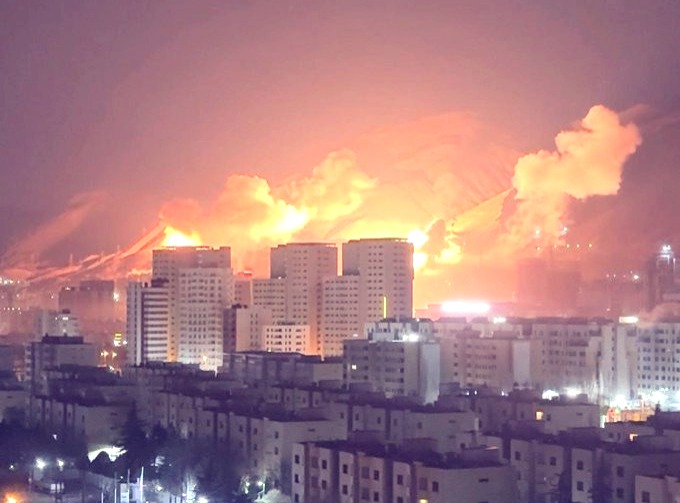
Dubai; March 2026: Bahrain, Jordan, Kuwait, Qatar, Saudi Arabia, UAE alongside the United States have issued a joint statement stating that they strongly condemn Iran’s “indiscriminate and reckless missile and drone attacks” across the Middle East. They said these “unjustified strikes” have “targeted sovereign territory, endangered civilian populations, and damaged civilian infrastructure”.
Tehran’s actions represent a dangerous escalation that threatens regional stability, the countries said, while reaffirming their rights to self defense while remaining united in the defense of their citizens.
Meanwhile, Lebanese PM Nawaf Salam has called the Hezbollah rocket attack on Israel ‘irresponsible’
says the attack was “an irresponsible and suspicious act that jeopardises Lebanon’s security and safety and provides Israel with pretexts to continue its aggression. We will not allow the country to be dragged into new adventures, and we will take all necessary measures to apprehend the perpetrators and protect the Lebanese people”, the Prime Minister said on X. It is Hezbollah who have claimed responsibility for the attack, saying that it was in response to the killing of Khamenei and Israeli violations against Lebanon. These projectiles were sent in retaliation for the killing of the Iranian supreme leader, after Israel and the US started their attack on Iran early on Saturday, which is a violation of the 2024 November ceasefire deal.
As it is well known that Israel have carried on attacking Hezbollah on Lebanese soil since the ceasefire started, but Hezbollah, on its end, had said it had remained committed to the ceasefire. The fighting enters its 03rd day, and yet another front has been opened, in Lebanon this time.
After the United States and Israel launched joint strikes on Iran on Saturday, killing Supreme Leader Ayatollah Ali Khamenei and several senior officials, Tehran was quick to respond. Iran said its retaliation targeted Israel and US-linked military sites across the region, including in Gulf states that host US forces.
Central to Iran’s response is its missile arsenal and the other platforms and tools at its disposal to inflict pain on the US and others. From ballistic missiles with a range of up to 2,000 kilometres (1,243 miles) and cruise missiles that can travel up to 2,500 kilometres (1,553 miles), drones, and the threat of making the Strait of Hormuz hard to use, Iran has several arrows in its quiver.
Unlike the 12-day war that the US and Israel waged on Iran in June 2025, Khamenei’s killing appears to have convinced Tehran that the clash is a battle for the Islamic Republic’s very survival. In Tehran’s narrative, delayed or restrained retaliation risks being seen as weakness and an invitation to further attacks. On Sunday, Iranian President Masoud Pezeshkian said seeking revenge for the killing of Khamenei and other senior officials is the country’s “duty and legitimate right”. But what are the ways in which Iran is taking that “revenge”?
Iran’s missile force is central to how it fights and signals. Defence analysts describe it as the Middle East’s largest and most varied, spanning ballistic and cruise missiles, and designed to give Tehran reach even without a modern air force. Iranian officials cast the country’s missile programme as the backbone of deterrence, in part because the air force relies on ageing aircraft. Western governments argue that Iran’s missiles fuel regional instability and could support a future nuclear delivery role, a claim Tehran rejects.
Long-range Iranian ballistic missiles: can travel between 2,000 kilometres (1,243 miles) and 2,500km (1,553 miles). That means that these missiles can reach Israel, US-linked bases across the Gulf and much of the wider region, but contrary to claims by Trump and some in his orbit, these missiles cannot come close to reaching the US.
Medium-range ballistic missiles: can travel roughly 1,500 – 2,000 kilometres (900-1,200 miles), and what turn retaliation into a regional equation. Systems such as Shahab-3, Emad, Ghadr-1, the Khorramshahr variants and Sejjil underpin Iran’s ability to hit further afield, alongside newer designs like Kheibar Shekan and Haj Qassem.
Sejjil stands out as a solid-fuel system, generally allowing faster launch readiness than liquid-fuel missiles, an advantage if Iran expects incoming strikes and needs survivable, responsive options.
These medium-range missiles place Israel and a wide arc of US-linked facilities in Qatar, Bahrain, Kuwait, Saudi Arabia and the United Arab Emirates within range, widening both Iran’s target list and the region’s exposure.
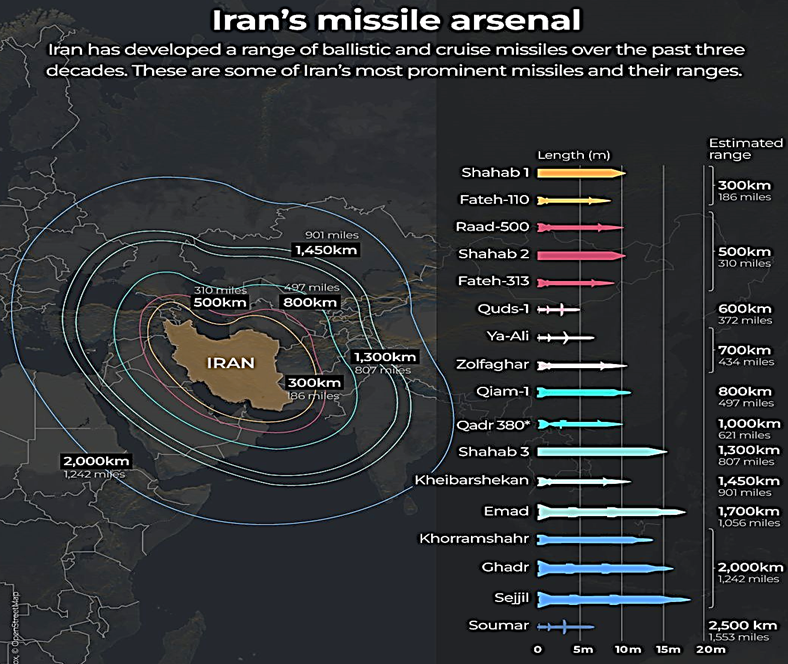
Short-range ballistic missiles: can travel roughly 150 – 800 kilometres (93-500 miles), are built for nearby military targets and rapid regional strikes.
Core systems include the Fateh variants: Zolfaghar, Qiam-1 and older Shahab-1/2 missiles. Their shorter range can be an advantage in a crisis. They can be launched in volleys, compressing warning time and making pre-emption harder. Iran have used this niche strategy in January 2020, firing ballistic missiles at Iraq’s Ain al-Assad airbase after the US killed Qassem Soleimani, the country’s highest-profile general. The attack damaged infrastructure and left more than 100 US personnel with traumatic brain injuries, demonstrating that Iran could inflict high costs without matching US air power.
Cruise missiles: fly low, can hug terrain, and are often harder to detect and track – especially when launched alongside drones or ballistic salvoes designed to overload air defences. Iran is widely assessed to field land-attack and antiship cruise missiles, such as Soumar, Ya-Ali, the Quds variants, Hoveyzeh, Paveh and Ra’ad. The Soumar has a range of 2,500 kilometres (1,553 miles).
Team Maverick.







PM Modi Receives Grand Welcome in Jakarta as Indonesia Visit Begins with Special Honours
Jakarta, July 2026: Prime Minister Narendra Modi arrived in Jakarta on Monday afternoon on…
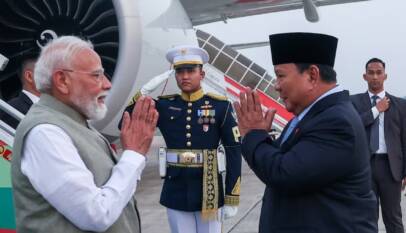
PM Modi Receives Grand Welcome in Jakarta as Indonesia Visit Begins with Special Honours
Jakarta, July 2026: Prime Minister Narendra Modi arrived in Jakarta on Monday afternoon on …