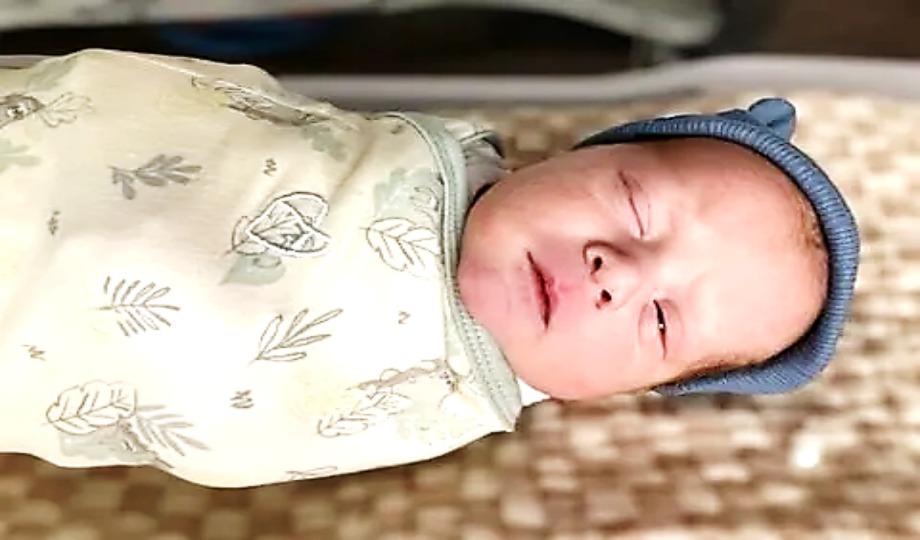
A Baby Borne on his 31st. Birthday called as the ‘World’s Oldest Baby’.

Thaddeus Daniel Pierce, born on Saturday, July 26, has the curious distinction of being the “world’s oldest baby”. He was conceived 31 years ago and frozen as an embryo in 1994, when his adoptive parents were just toddlers. Lindsey Pierce (35 Years), and Tim Pierce (34 Years), from London, Ohio, decided to adopt the Clinton-era embryo and go through in vitro fertilization after struggling to conceive for nearly eight years.
It is mention worthy that, Thaddeus was one of three leftover embryos frozen for an IVF procedure. The mother, Linda Archerd, wanted to save extra embryos in case she wished to expand her family in the future. After filing for divorce, she placed the embryos up for adoption. Lindsey and Tim Pierce were matched with the embryo through a Christian embryo adoption program, Snowflake Open Hearts, which hosts embryos that are hard to place. The program seeks couples who are “open to embryos, regardless of medical history, the age of the embryos, grade, or quality assigned”.
Lindsey had a difficult birth, but has recovered. She says her church and her family think that, “it’s like something from a sci-fi movie. The baby has a 30-year-old sister”, she adds. Tim was a toddler when the embryos were first created.
The story starts back in the early 1990s, when Linda Archerd had been trying, and failing, to get pregnant for six years. She and her husband decided to try IVF, a fairly new technology at the time. “People were unfamiliar with it”, says Archerd. “A lot of people were like, what are you doing?” They did it anyway, and in May 1994, they managed to create four embryos. One of them was transferred to Linda’s uterus. It resulted in a healthy baby girl. “I was so blessed to have a baby”, Archerd says. The remaining three embryos were cryopreserved and kept in a storage tank.
That was 31 years ago. The healthy baby girl is now a 30-year-old woman who has her own 10 years old daughter. But the other three embryos remained frozen in time. Archerd originally planned to use the embryos herself. “I always wanted another baby desperately. I called them my three little hopes”. Her then husband felt differently, she says. Archerd went on to divorce him, but she won custody of the embryos and kept them in storage, still hopeful she might use them one day, perhaps with another partner. But the storage meant paying annual storage fees, which increased over time and ended up costing Archerd around a thousand dollars a year, she says. To her, it was worth it. “I always thought it was the right thing to do”, she says.
Things changed when she started going through menopause, she says. She considered her options. She didn’t want to discard the embryos or donate them for research. And she didn’t want to donate them to another family anonymously—she wanted to meet the parents and any resulting babies. “It’s my DNA; it came from me … and it’s my daughter’s sibling”, she says.
Then she found out about embryo “adoption”. This is a type of embryo donation in which both donors and recipients have a say in whom they “place” their embryos with or “adopt” them from. It is overseen by agencies—usually explicitly religious ones—that believe an embryo is morally equivalent to a born human. Archerd is Christian. There are several agencies that offer these adoption services in the US, but not all of them accept embryos that have been stored for a very long time. That’s partly because those embryos will have been frozen and stored in unfamiliar, old-fashioned ways, and partly because old embryos are thought to be less likely to survive thawing and transfer to successfully develop into a baby.
“So many places wouldn’t even take my information”, says Archerd. Then she came across the Snowflakes program run by the Nightlight Christian Adoptions agency. The agency was willing to accept her embryos, but it needed Archerd’s medical records from the time the embryos had been created, as well as the embryos’ lab records. Archerd then had called the fertility doctor who had treated her decades before. “I still remembered his phone number by heart”, she says. That doctor, now in his 70s, is still practicing at a clinic in Oregon. He dug Archerd’s records out from his basement, she says. “Some of them were handwritten,” she adds. Her embryos entered Nightlight’s “matching pool” in 2022.
“Our matching process is really driven by the preferences of the placing family”, says Beth Button, executive director of the Snowflakes program. Archerd’s preference was for a married Caucasian, Christian couple living in the US. “I didn’t want them to go out of the country”, says Archerd. “And being Christian is very important to me, because I am”.
It took a while to find a match. Most of the “adopting parents” signed up for the Snowflakes program were already registered at fertility clinics that wouldn’t have accepted the embryos, says Button. “I would say that over 90% of clinics in the US would not have accepted these embryos”, she says. Archerd’s embryos were assigned to the agency’s Open Hearts program for embryos that are “hard to place”, along with others that have been in storage for a long time or are otherwise thought to be less likely to result in a healthy birth.
Lindsey and Tim Pierce had also signed up for the Open Hearts program. The couple, aged 35 and 34, respectively, had been trying for a baby for seven years and had seen multiple doctors. Lindsey was researching child adoption when she came across the Snowflakes program. When the couple were considering their criteria for embryos they might receive, they decided that they’d be open to any. “We check marked anything and everything”, says Tim. That’s how they ended up being matched with Archerd’s embryos. “We thought it was wild”, says Lindsey. “We didn’t know they froze embryos that long ago”. So around six years ago, he set up Rejoice Fertility with the aim of doing things differently.
“Now we’re here in the belt buckle of the Bible Belt”, says Gordon, who is Reformed Presbyterian. “I’ve changed my mode of practice”. IVF treatments performed at the clinic are designed to create as few excess embryos as possible. The clinic works with multiple embryo adoption agencies and will accept any embryo, no matter how long it has been in storage. It was his clinic that treated the parents who previously held the record for the longest-stored embryo in 2022, Rachel and Philip Ridgeway had twins from embryos created more than 30 years earlier. “They’re such a lovely couple”, says Gordon.
“We have certain guiding principles, and they’re coming from our faith”, says Gordon, although he adds that he sees patients who hold alternative views. One of those principles is that “every embryo deserves a chance at life and that the only embryo that cannot result in a healthy baby is the embryo not given the opportunity to be transferred into a patient”.
In the early days of IVF, embryos earmarked for storage were slow-frozen. This technique involves gradually lowering the temperature of the embryos. But because slow freezing can cause harmful ice crystals to form, clinics switched in the 2000s to a technique called ‘vitrification – in which the embryos are placed in thin plastic tubes called straws and lowered into tanks of liquid nitrogen. This rapidly freezes the embryos and converts them into a glass-like state’.
The embryos can later be thawed by removing them from the tanks and rapidly within two seconds plunging them into warm “thaw media”, says Atkinson. Thawing slow-frozen embryos is more complicated. And the exact thawing method required varies, depending on how the embryos were preserved and what they were stored in. Some of the devices need to be opened while they are inside the storage tank, which can involve using forceps, diamond-bladed knives, and other tools in the liquid nitrogen, says Atkinson.
The record-breaking embryos had been slow-frozen and stored in a plastic vial, says Atkinson. Thawing them was a cumbersome process. But all these three embryos survived it. Lindsey & Tim Pierce had to travel from their home in Ohio to the clinic in Tennessee five times over a two-week period. “It was like a five-hour drive”, says Lindsey. One of the three embryos stopped growing. The other two were transferred to Lindsey’s uterus on November 14, she says. And one developed into a fetus.
Now that the baby has arrived, Archerd is keen to meet him. “The first thing that I noticed when Lindsey sent me his pictures is how much he looks like my daughter when she was a baby”, she says. “I pulled out my baby book and compared them side by side, and there is no doubt that they are siblings”. She doesn’t yet have plans to meet the baby, but doing so would be “a dream come true”, she says. “I wish that they didn’t live so far away from me … He is perfect! We didn’t go into it thinking we would break any records, we just wanted to have a baby”, says Lindsey.
Team Maverick







Suryavanshi’s 17-Ball Blitz Powers Rajasthan Royals to Dominant Win Over CSK
Guwahati, March 2026 : A sensational knock by Vaibhav Suryavanshi powered the Rajasthan Ro…

Suryavanshi’s 17-Ball Blitz Powers Rajasthan Royals to Dominant Win Over CSK
Guwahati, March 2026 : A sensational knock by Vaibhav Suryavanshi powered the Rajasthan Royals …