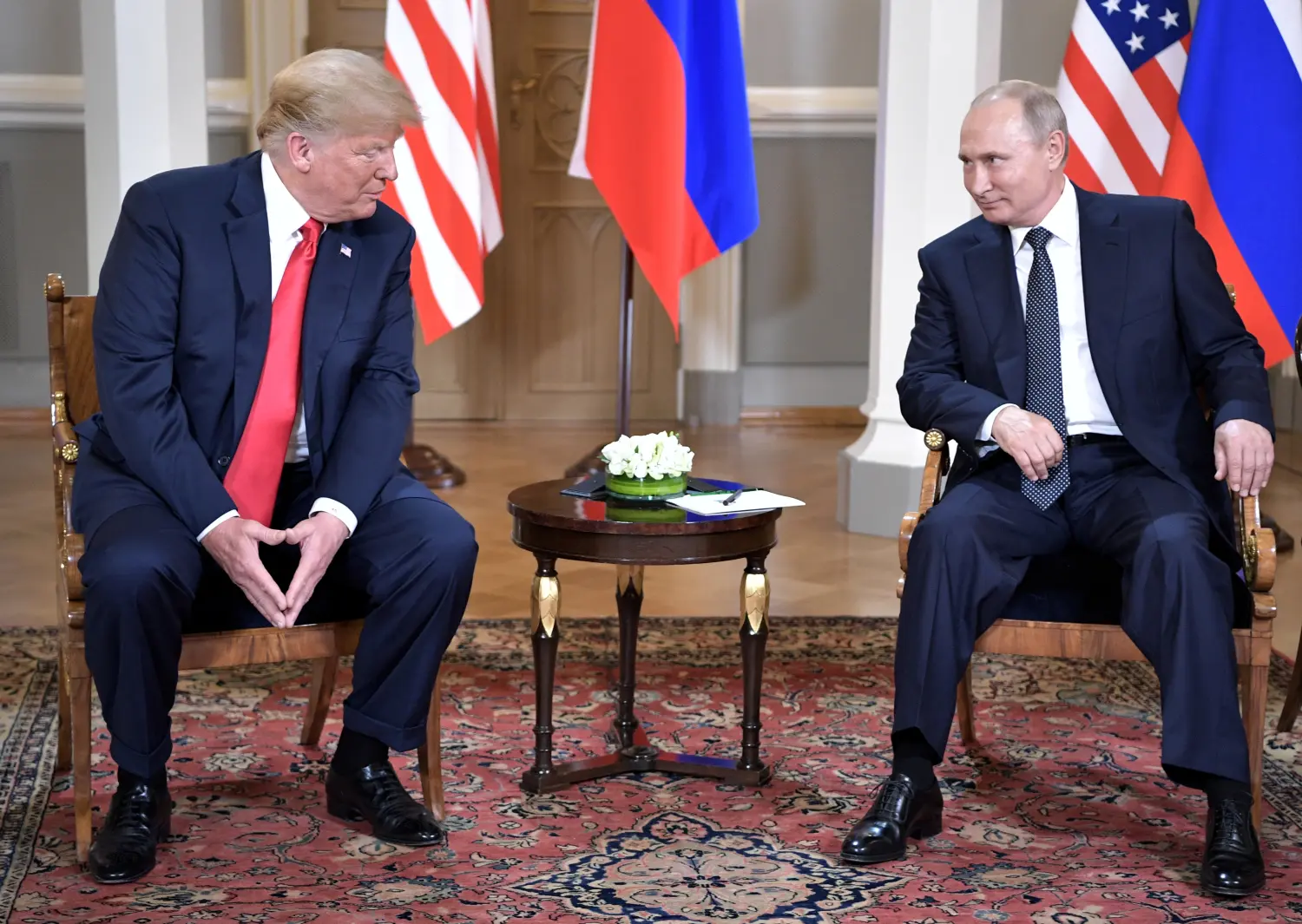
Trump–Putin Alaska Summit Set to Address Ukraine War Amid Deep Divisions

Washington / Moscow, Aug 2025 : US President Donald Trump and Russian President Vladimir Putin will meet on Friday at a US air base in Alaska for high-stakes talks aimed at finding a path toward ending the war in Ukraine. It will be the first summit between a sitting US and Russian president in more than four years, and the first time Putin has set foot in a Western country since launching his full-scale invasion in February 2022.
The meeting marks Putin’s first visit to the United States in a decade, underscoring the extraordinary nature of the encounter. Yet despite the symbolic significance, expectations remain cautious. Moscow and Kyiv are still far apart on the terms of a settlement, and the gap between their visions appears as wide as ever.
Russia’s Aims
For Putin, the Alaska summit is more than a diplomatic engagement — it is a chance to press Russia’s uncompromising demands directly to Washington. Isolated from most Western capitals for over two years, the Kremlin leader sees this as an opportunity to legitimise his position and force discussion on his preferred terms.
In June, Russia unveiled a draft peace proposal calling for Ukraine to withdraw its forces from the four regions Moscow claimed to annex in 2022 — Kherson, Lugansk, Zaporizhzhia, and Donetsk. Ukraine swiftly rejected the plan, saying it amounted to surrendering sovereign territory.
Russia has also demanded that Ukraine halt military mobilisation, abandon its NATO membership ambitions, and that Western countries immediately cease supplying arms to Kyiv. Critics say these demands effectively call for Ukraine’s capitulation.
Beyond the territorial issue, Moscow insists that Ukraine must safeguard the “rights and freedoms” of Russian-speaking communities and ban what it describes as the “glorification of Nazism.” Ukraine calls such accusations unfounded, noting that rights for Russian speakers are already enshrined in law.
The Kremlin has also tied any agreement to the lifting of Western sanctions, a point that remains one of the most contentious in the talks.
Ukraine’s Position
Ukrainian President Volodymyr Zelensky will not be present in Alaska, but he has made his position clear: there can be no settlement without Ukraine at the table. He has described the Trump–Putin meeting as a “personal victory” for the Russian leader, warning against backroom deals that sideline Kyiv.
Ukraine has set out its own prerequisites for peace talks, starting with an unconditional ceasefire across land, sea, and air. It also demands the release of all prisoners of war on both sides and the return of Ukrainian children that Kyiv says have been illegally taken to Russia.
According to Ukraine, thousands of children have been forcibly transferred since the start of the war, often adopted into Russian families and granted Russian citizenship. Moscow denies kidnapping them but admits that thousands of Ukrainian minors are now on Russian territory.
Kyiv insists that any deal must include binding security guarantees to prevent future Russian aggression, as well as freedom to maintain whatever troop levels it deems necessary. On sanctions, Ukraine says they should only be lifted gradually, with mechanisms to reimpose them if Russia breaches the agreement.
The United States’ Role
President Trump has repeatedly pledged to end the war “within 24 hours” of taking office in January, but eight months into his term, that promise remains unfulfilled. Despite multiple phone calls with Putin and several visits to Moscow by US envoy Steve Witkoff, the White House has secured no significant concessions from the Kremlin.
Friday’s summit will be Trump’s first in-person opportunity to broker a deal. Speaking on Wednesday, he warned that Russia would face “very severe consequences” if it did not halt its offensive. Early in the week, Trump had suggested there might be “land swapping” discussions at the summit, but he appeared to soften that stance after consultations with European leaders.
The US president has said he would like to see a ceasefire “very, very quickly,” though his aides have been careful to manage expectations. The White House has characterised the meeting as a “listening exercise” rather than a venue for immediate breakthroughs. Trump himself has hinted that a follow-up summit could include Zelensky if initial talks go well.
Europe on the Sidelines
While Europe has borne much of the humanitarian and economic cost of the war — from supplying weapons to hosting millions of refugees — European leaders have been excluded from recent high-level negotiations. They were not present at three previous Russia–Ukraine meetings in Istanbul, nor at the Russia–US talks held in Riyadh earlier this year.
Last week, the leaders of Britain, France, Italy, Germany, Poland, Finland, and the European Commission issued a joint statement warning that no legitimate peace deal could be reached without Ukraine’s full participation. French President Emmanuel Macron was explicit: “Territorial questions concerning Ukraine can be, and will be, negotiated only by the Ukrainian president.”
Macron and UK Prime Minister Keir Starmer have expressed willingness to deploy international peacekeepers to Ukraine once the fighting ends — a proposal Russia has categorically rejected. Moscow insists that any foreign troops on Ukrainian soil would be a violation of its security interests.
Challenges Ahead
The Alaska meeting comes against the backdrop of entrenched military positions on the ground. While front-line fighting has slowed in some areas, both sides continue to conduct strikes and counter-strikes, and neither has made significant territorial gains in recent months.
Diplomatically, the two leaders face a steep climb. Russia’s maximalist demands clash directly with Ukraine’s insistence on sovereignty and full territorial integrity, while Washington must navigate between showing flexibility and maintaining solidarity with its European allies and Kyiv.
Observers note that Putin’s decision to attend signals confidence that he can shape the narrative to Russia’s advantage, particularly if the summit is perceived as elevating his international stature. For Trump, the challenge is balancing his stated ambition to quickly end the war with the geopolitical realities that limit the scope for compromise.
With no European participation, and Ukraine absent from the table, critics fear that any preliminary framework reached in Alaska may be viewed as lacking legitimacy. Yet supporters of the meeting argue that direct US–Russia dialogue is a necessary first step, even if substantive progress takes time.
As Air Force One and the Russian presidential aircraft prepare to land in Alaska, the world’s attention will turn to a remote military air base in America’s far north. Whether the talks mark the beginning of a genuine peace process or simply another episode in a long diplomatic stalemate remains to be seen.




Vice-President Congratulates Prime Minister Narendra Modi on Becoming Bharat’s Longest Continuously Serving Elected Prime Minister
Vice-President Hails Prime Minister Modi’s Visionary Leadership and Commitment to ‘Rashtra…

Vice-President Congratulates Prime Minister Narendra Modi on Becoming Bharat’s Longest Continuously Serving Elected Prime Minister
Vice-President Hails Prime Minister Modi’s Visionary Leadership and Commitment to ‘Rashtra Pratham’ Vice-President Praises …