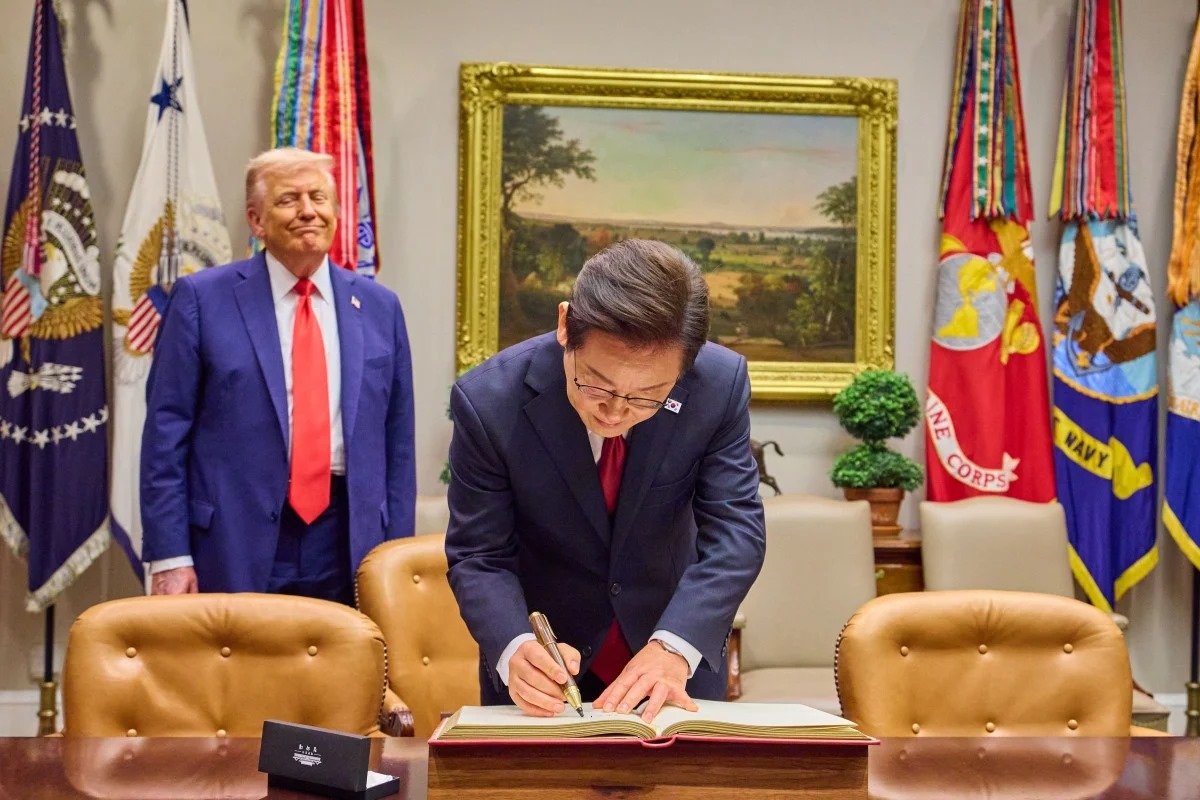
Donald Trump’s US$350 billion demand from South Korea demonstrates economic plunder.

Sept 2025 : Under a framework agreement reached in July, the United States offered to reduce proposed tariffs on South Korean imports from 25% to 15%, but only if Seoul pledged to invest the US$350 billion into sectors chosen by Washington and made additional concessions. Following up during President Lee Jae-Myung’s visit to Washington last month, have reached an impasse over the structure of the investment package, profit-sharing mechanisms and other conditions.
US Commerce Secretary Howard Lutnick bluntly asserted last week that South Korea must accept the deal or face higher tariffs while affirming that Japan had already agreed to similar terms. “The devil is in the details”, as Lutnick put it on Thursday.
US President Donald Trump has been sharply critical of South Korea, calling it a rich “money machine” that exploits its alliance with America, citing trade surpluses he claims are evidence of unfair practices.
Analysts however cautioned against drawing parallels with Japan. They note that South Korea’s economy is roughly half the size of Japan’s, with foreign exchange reserves of around US$416 billion – less than one-third of Tokyo’s US$1.32 trillion. And unlike the yen, South Korea’s won is not freely convertible and lacks reserve currency status, leaving Seoul with far less room to manoeuvre.
“South Korea is being coerced to drink from a poisoned chalice. If we accept the US demand as it is, this country would simply go belly up,” said Hur Jung, an economics professor at Sogang University in Seoul. “The country’s foreign exchange reserves would become depleted and the won’s value would plunge, sparking a foreign exchange crisis that would make the 1997 IMF bailout look mild by comparison”.
The deal Washington is pushing would require the South Korean government to channel its investments into US-designated special purpose companies. Profits would be split 90-10 in Seoul’s favour until the investment principal is recouped, after which the US share would surge to 90%. US$350 billion amounts to 84% of South Korea’s foreign reserves, compared with Japan’s US$550 billion pledge which is 41.6% of its far larger holdings.
Crucially, Japan’s yen enjoys global convertibility, giving Tokyo access to virtually unlimited dollar liquidity through currency swaps with the US, a luxury not afforded to Seoul. “This is an impossible demand for South Korea to accept in light of the size of its economy, its currency’s market status and foreign exchange position”, Hur said. “In the face of this nonsensical demand that goes beyond international trade practices, it’s no surprise that negotiations can’t proceed”.
South Korea can raise no more than US$20 billion to US$30 billion annually from foreign exchange markets, according to senior presidential aide Kim Yong-beom. Immediately after the July agreement was announced, Kim clarified that most of the US$350 billion would have to be raised through loans and guarantees from institutions such as the Export-Import Bank of Korea and the Korea Trade Insurance Corporation, with only a fraction as direct equity. But Washington is reportedly pressing Seoul to follow Japan’s model and provide the entire US$350 billion sum in cash as direct investment.
Facing acute liquidity constraints, South Korea has appealed for dollar swaps with the US, a request American official have so far rebuffed. “In fact, the negotiation has hit a stumbling block over this issue”, Kim told reporters.
President Lee publicly vowed last week never to make a decision that undermined the national interest, dismissing speculation of a secret deal. Asked why he had not signed the agreement during the summit in Washington, unlike Japan, Lee replied: “Why would I sign when it’s not beneficial to do so? … We should aim to sign in the most reasonable way possible. Don’t criticise me for not signing it yet.”
The economic risks have not been lost on international observers. Economist Dean Baker, co-founder of the Centre for Economic and Policy Research think tank in Washington, noted that Trump had openly boasted about forcing Japan and South Korea to fork over billions of dollars in exchange for lower tariffs. “If they are anywhere close to the way Trump describes them, the countries’ economies would be plundered”, Baker wrote in an article published last week. “But it gets worse. Trump does not feel bound by any of his deals. He can easily come back and demand more money from Japan next year or later on, as his business associates have learned the hard way, deals mean nothing to Donald Trump”.
“The US demand is beyond the pale of market capitalism. It’s naked imperialism”, said Nah Won-Jun, Korean economics professor at Kyungpook National University.
South Korea have exported US$132 billion worth of goods to the US last year, equivalent to roughly 7.3% of its gross domestic product. If US tariffs reduce exports by 05%, the loss would amount to US$7 billion. Yet to protect these exports, Trump is demanding US$350 billion – an exchange analysts say defies economic logic. The US$350 billion figure represents about 70% of South Korea’s annual budget, according to Nah Won-Jun. “If South Korea accepts this unfair deal, it would deal a fatal blow to its economy. If the invested US projects fail, in a situation where South Korea can’t recover its investments, Korean taxpayers would have to shoulder the burden and live like slaves”.
Nah further said that Seoul would be better off absorbing the pain of higher US tariffs and accelerating efforts to diversify its export markets no simple feat, as South Korea has already been pivoting away from China towards the US amid rising geopolitical tensions.
Still, the dilemma is acute. “We cannot afford to give up the US market, given its dominant size, enormous purchasing power and robust growth potential”, said Yang Joo-young, trade policy director at the Korea Institute for Industrial Economics and Trade.
Meanwhile, South Korean corporations have separately announced US$150 billion in additional US investments, including Korean Air’s US$50 billion order for 103 Boeing aircraft.
But these commitments do little to ease Seoul’s looming financial squeeze.
Team Maverick






France Likely to Respond by Mid-August on India’s Mega 114-Rafale Fighter Jet Proposal
New Delhi, July 2026 : France is expected to submit its official response by mid-August to…
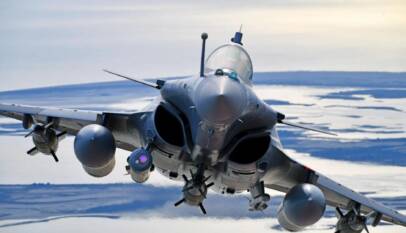
France Likely to Respond by Mid-August on India’s Mega 114-Rafale Fighter Jet Proposal
New Delhi, July 2026 : France is expected to submit its official response by …