Copenhagen Summit: European leaders face numerous security challenges.

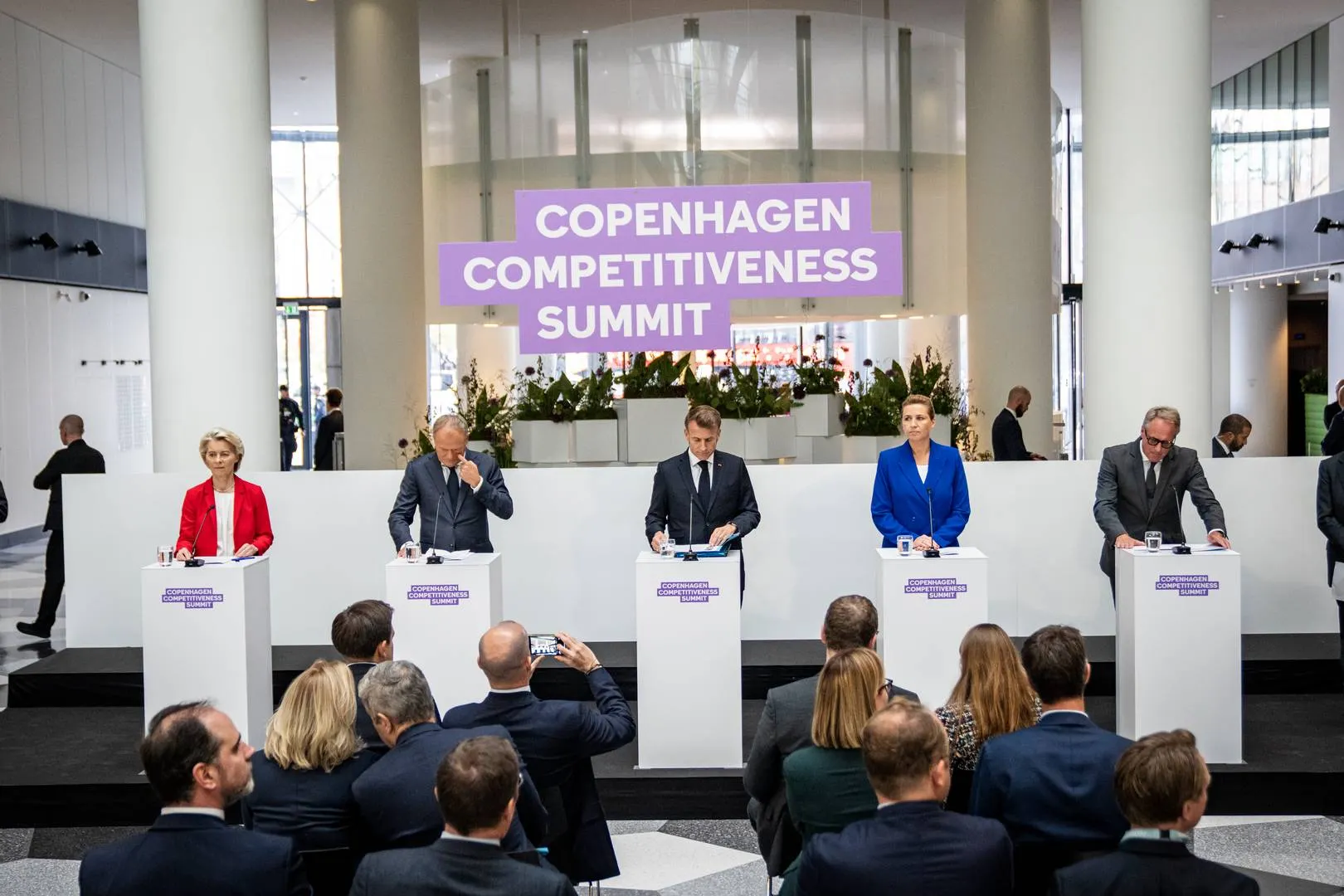
Oct 2025 : On October 1, 2025, European leaders gathered for an informal summit in Copenhagen, Denmark, to discuss ways to strengthen their common defense and support for Ukraine. The meeting took place under heightened security following recent drone incursions into Danish airspace. The summit discussed the immediate threats facing the continent, with Russia and its destabilization operations in particular in the spotlight, according to a statement by European Council President Antonio Costa.
Earlier on 30th September, 2025, European Commission President Ursula von der Leyen had asserted, that the EU must provide a “strong and united” response to violations of airspace at European borders by Russian drones. The defense of member states, and in particular the establishment of a “European drone wall”, were also among the key topics at the meeting.
The Commission confirmed that it is working on the establishment of an anti-drone wall. The discussion was partly based on a Commission policy brief, which proposes several “flagship projects”, including one dedicated to “surveillance of the eastern flank”, from Finland to Central Europe via the Baltic states. However, “Europe’s borders will only be secure if all of Europe’s borders are secured through a 360-degree approach”, as summarised by Portuguese President of the European Council, Antonio Costa.
In the current geo-political state, the speech delivered by EC President Ursula Von Der Leyen is considered to be a trend setter, as Russia mounts aerial attacks on NATA partners. The speech reads,
“It is a pleasure to welcome you to the 5th edition of our Security College. I convened this meeting to discuss the security situation in Europe and to listen to your views. Preserving peace has always been a fundamental mission of the European Union, and while the instruments have evolved over time, the objective has remained the same. It has now been three years and seven months since Russia invaded Ukraine. Ukraine continues to resist on the battlefield and has ceded virtually no territory this year. In the past 1,000 days, Russia has conquered only 1% of occupied Ukrainian territory. This is despite the fact that more than a quarter of a million Russians have lost their lives on the battlefield this year. Russia is also under increasing economic pressure. Interest rates stand at 17% and inflation is well above 10%. I am convinced that we are at a turning point and that decisive action on our part can turn this conflict around.
In recent months, we have already taken unprecedented steps. We have set out our strategic direction and priorities in a White Paper and proposed new ways of financing defence. The ad hoc SAFE instrument, now operational, was set up in record time for this purpose. We will discuss the way forward tomorrow at the informal European Council.
In terms of European defense, I believe there are three relevant themes:
First, capabilities. We have a unique set of forces, assigned to different missions related to NATO, the EU, the UN, or the Coalition of the Willing. That is why we need interoperable capabilities, in close cooperation with NATO. To achieve this, we must increase joint procurement.
Second, we need flagship defense projects. We must act now, for example under the Eastern Flank Watch initiative. Europe must respond strongly and unitedly to Russian drone incursions on our borders. That is why we will propose immediate measures to create an anti-drone wall as part of this project. We must act quickly, in collaboration with Ukraine and in close coordination with NATO.
Third, our defense industry must be ready for action. A strengthened, resilient, and innovative European defense industry is essential to successfully carry out our rearmament. The industry must be able to deliver cutting-edge military equipment quickly and on a large scale. This, in a nutshell, is an overview of some of the key elements of the guidance document. In two weeks, we will present the full roadmap of our 2030 readiness plan.
Finally, on Ukraine, we are making progress on several fronts. First, we are increasing economic pressure on Russia. Our sanctions are bearing fruit. Russian growth is projected to slow from 4.3% in 2024 to 0.9% in 2025. We must increase this pressure. To this end, we have proposed strong new measures in the areas of energy, financial services, and trade under the 19th sanctions package. One of its key elements is the ban on LNG imports from Russia. Second, we must provide military assistance to Ukraine. If we continue to consider Ukraine as our first line of defense, we must strengthen our military assistance. Concretely, we have agreed with Ukraine to dedicate €2 billion to financing drones. This will allow Ukraine to increase its production capacity in this sector and the EU to benefit from this technology. However, a more structural solution to military support is needed for the porcupine strategy to succeed. That is why I have proposed the idea of a reparations loan based on Russia’s tied-up sovereign assets. This loan would not be paid all at once, but in installments, and would come with strings attached. We will strengthen our own defense industry by ensuring that part of it is used for purchases in and with Europe. It should be emphasized that there is no question of asset seizure. Ukraine will have to repay the loan if Russia pays reparations. Whoever is responsible for this war must be held accountable”.
Team Maverick



US-Led Israel-Lebanon Peace Talks to Resume in Rome from August 4
Washington, July 2026 : The United States will host the next round of negotiations between…

US-Led Israel-Lebanon Peace Talks to Resume in Rome from August 4
Washington, July 2026 : The United States will host the next round of negotiations …