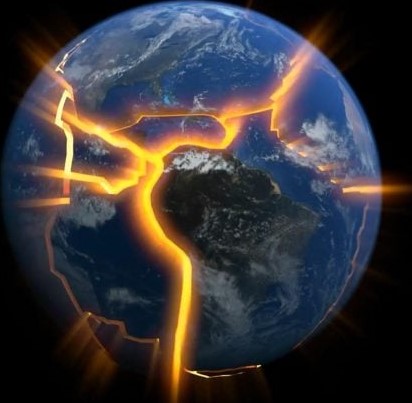
Earth Crust is breaking apart off the Pacific Northwest.

“Scientists have captured an unprecedented glimpse of a subduction zone in the act of dying,
where the Juan de Fuca and Explorer plates are breaking apart beneath North America
off the coast of Vancouver Island. Using high-resolution seismic imaging, researchers found
the Cascadia subduction zone is unravelling piece by piece, creating microplates
and revealing how Earth’s tectonic engines shut down over millions of years”.
With unprecedented clarity, researchers have captured a rare geological event: a subduction zone, the point where one tectonic plate sinks beneath another, is actively fracturing. The finding offers new insight into the dynamic processes shaping Earth’s crust and raises important questions about long-term earthquake risks in the Pacific Northwest.
Subduction zones are among Earth’s most powerful and influential geological systems. They propel continents across the globe, generate catastrophic earthquakes and volcanic eruptions, and recycle the planet’s crust back into the mantle. However, these colossal systems don’t last forever. If subduction zones never ended, continents would continually collide and merge, eliminating oceans and erasing the planet’s geologic history. For decades, scientists have asked one key question: what exactly causes these immense systems to come to an end?
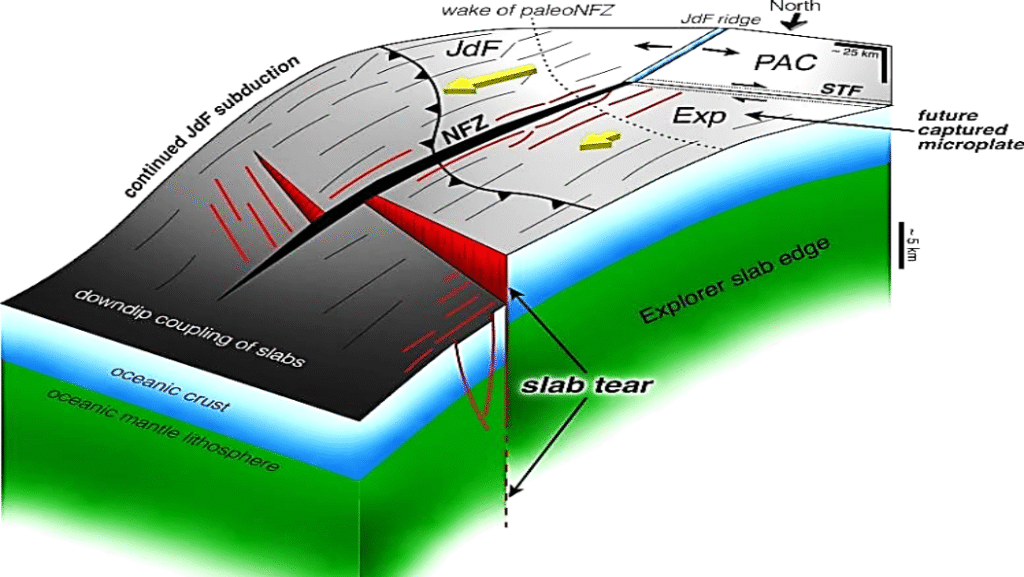
(The Cascadia subduction zone, where the Juan de Fuca (JdF) and Explorer (Exp) plates slowly move beneath the North American plate, is gradually shutting down piece by piece, with slabs breaking off while the remaining plate continues to subduct until the next rupture occurs).
Just off Vancouver Island, in the Cascadia region where the Juan de Fuca and Explorer plates slowly descend beneath the North American plate, scientists believe they have found the answer. By clubbing seismic reflection imaging, essentially an ultrasound of Earth’s interior, with extensive earthquake data the team observed a subduction zone in the process of breaking apart.
The seismic readings were obtained during the NSF-supported 2021 Cascadia Seismic Imaging Experiment (CASIE21). During this expedition, researchers aboard a ship sent sound waves into the seafloor and tracked their reflections using a 15 kilometre streamer of underwater sensors. The data produced detailed images of the region’s subsurface, exposing deep fractures and fault lines where the tectonic plate is beginning to split.
“This is the first time we have a clear picture of a subduction zone caught in the act of dying”, said Brandon Shuck, a geologist at Louisiana State University. “Rather than shutting down all at once, the plate is ripping apart piece by piece, creating smaller microplates and new boundaries. So instead of a big train wreck, it’s like watching a train slowly derail, one car at a time”.
Brandon Shuck and his team observed tears slicing through the oceanic plate, including a massive offset where the slab has dropped by about five kilometres. “There’s a very large fault that’s actively breaking the plate,” Shuck explained. “It’s not 100% torn off yet, but it’s close”. Earthquake records confirm the pattern: along the 75-kilometer-long tear, some sections are still seismically active, while others are eerily quiet. “Once a piece has completely broken off, it no longer produces earthquakes because the rocks aren’t stuck together anymore”, he said. That missing gap of seismicity is a telltale sign that part of the plate has already detached and the gap is growing slowly over time.
The study have found that this breakup happens in stages, through what researchers call “episodic” or “piecewise” termination. Rather than a sudden break across the entire tectonic plate, the plate gradually tears apart one section at a time. Transform boundaries generally faults where plates slide past each other playing a key role in this process. Acting like natural scissors, these faults cut across the plate, perpendicularly to the tear, allowing one piece to detach and form a microplate while subduction continues in neighbouring sections.
By tearing off in smaller chunks, the larger plate loses momentum, like cutting the cars off a runaway train, and eventually stops being pulled downward. Each piece that breaks away is a process that takes several million years, but together these episodes gradually shut down an entire subduction system.
This episodic breakup helps explain puzzling features in Earth’s history preserved elsewhere, such as abandoned fragments of tectonic plates and unusual bursts of volcanic activity. A striking example lies off Baja California, where scientists have long observed fossil microplates, which are the shattered remains of the once-massive Farallon plate. For decades, researchers knew these fragments must be evidence of dying subduction zones, but the mechanism that created them was unclear. Cascadia is now providing that missing piece: subduction zones don’t collapse in a single catastrophic event but unravel step by step, leaving behind microplates as geological evidence.
And the process isn’t over. As each fragment detaches, it reshapes Earth’s surface. The torn edges may create “slab windows” where hot mantle rises, fuelling bursts of volcanic activity. Over time, the plate boundaries migrate, new microplates form, and the cycle repeats. “It’s a progressive breakdown, one episode at a time. And it matches really well with what we see in the geologic record, where volcanic rocks get younger or older in a sequence that reflects this step-by-step tearing”.
Looking ahead, researchers are exploring whether a major earthquake could rupture across one of these newly discovered tears or whether the breaks might influence how ruptures propagate. While these findings help refine models of how structural complexities affect earthquake behaviour, they do not significantly change the hazard outlook for Cascadia on a human timescale. The region remains capable of producing very large earthquakes and tsunamis, and understanding how these new breaks influence rupture patterns will improve models used to study seismic hazards in the Pacific Northwest.
Team Maverick







₹30.41 Crore Road Project Receives Administrative Approval Due to Efforts of Minister Lakshmi Rajwade
Raipur, March 2026: Significant progress has been made in road infrastructure development …

₹30.41 Crore Road Project Receives Administrative Approval Due to Efforts of Minister Lakshmi Rajwade
Raipur, March 2026: Significant progress has been made in road infrastructure development in the …