In Romania NATO Members would fill the void created by the departure of US Forces.

NATO members will provide troops to fill the void created by the departure of US soldiers from Romania, the country’s Foreign Minister Oana Toiu told media personnel, while leaving the alliance with a “stronger” presence. While addressing the media on October 30th, Toiu said “of course, we all wanted this US military presence to continue unchanged or for there to be scenarios in which this presence will be increased”. Nevertheless, she added, the decision by the United States was taken on the basis of a justified analysis by US, that European NATO members need to “increase our own defence capacity”.
The news of the troop cuts was officially announced by Romanian Defence Minister Ionut Mosteanu on October 29th. He said about 1,000 troops would not be replaced after their recent rotation through Romania, but that a similar number would remain in three US bases in the country.
US/NATO Bases In Romania –
According to Romania’s Ministry Of Defence, there were approximately 1,700 US soldiers stationed in the country at the start of 2025.
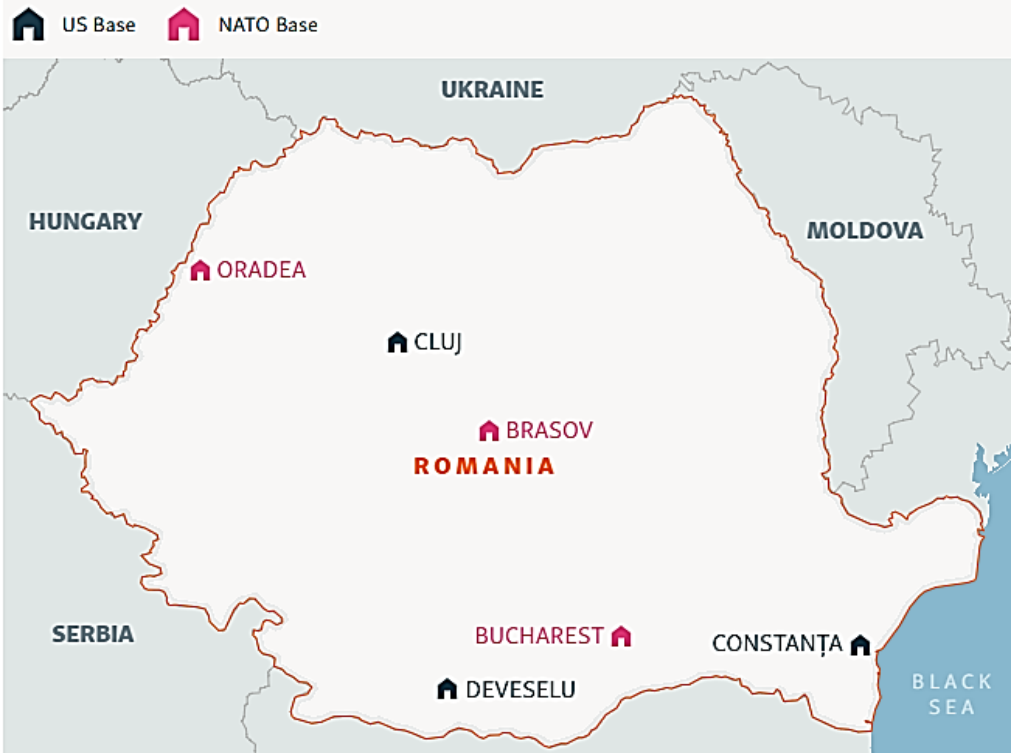
“By the end of this year and the beginning of the next year, we will see a stronger NATO presence in Romania and a stronger NATO capacity to intervene in case Romania is subject to a direct threat”, Toiu said. When asked by the Press, as to whether this would be composed of other allied nations, rather than American troops, she said “we are talking about allied forces, Yes!”. Toiu’s comments echoed the tone taken by other Romanian officials to tamp down concern after news of the US withdrawal was announced.
Earlier on October 30th, US President Donald Trump appeared to play down the importance of the decision as he spoke to reporters on Air Force One while flying back from South Korea to Washington.
“I can tell you about it but it’s not very significant. It’s not a not a big deal”, Trump said when asked about the military drawdown.
But the decision to reduce numbers has drawn unusual criticism from Republican Defence policy experts in Washington. In a joint statement, the Chairmen of the Senate and House armed services committees, Roger Wicker and Mike Rogers, said they “strongly oppose” the move. “Our European allies have agreed to shoulder historic levels of the burden of collective Defence. However, European rearmament will take time”, the Republican duo has written.
“Pulling back US forces from NATO’s Eastern flank prematurely, and just weeks after Russian drones violated Romanian airspace, undermines deterrence and risks inviting further Russian aggression”, they added.
US troop reductions in Europe have been expected for several months since it was announced the Pentagon would conduct a Global Force Posture Review. There has been no official announcement of the United States reducing its military deployments elsewhere in Europe, but the move to cut troops in Romania comes amid heightened anxiety about the US commitment to NATO at a time when Russia has invaded Ukraine, sparking Europe’s biggest and deadliest conflict since World War II.
In a statement on the force reduction, the US Army stressed that it maintained “a robust presence” in Europe to “meet objectives including President Trump’s commitment to defend NATO allies”.
Nevertheless, Wicker and Rogers said they would seek assurances from the Pentagon that “as the President has previously stated, the two armored brigades in Poland remain in place, and that the United States continues to sustain a persistent rotational presence in Poland, the Baltic states, and Romania”.
Poland’s Defence Minister Wladyslaw Kosiniak-Kamysz told reporters on October 29th, that his country had “not received any information about a reduction in the contingent in Poland“.
A Romanian Army’s Reserve Officer with decades of experience in national and NATO commands asserted that “Romania has failed to develop a direct relationship with the US, on the model of Poland, which was promised, through the voice of the US president, that 8,000 American soldiers would remain there“. Relations between Bucharest and the Trump administration were strained by Romania’s decision to cancel presidential elections last year, citing Russian election interference, after a relatively unknown candidate won the first round of voting.
The move was strongly condemned by US Vice President JD Vance, who said it was undemocratic, but pro-Russian nationalist candidate Calin Georgescu was in any case disqualified from the election rerun in May.
Meanwhile continuing her interaction with the media personnel, Foreign Minister Oana Toiu told that, “trust is rebuilding” in the relationship with Washington. “It is not vulnerable. It is a partnership of mutual trust with common future objectives”.
Meanwhile, Estonia’s Defence Minister Hanno Pevkur issued a statement on October 30th stating Washington had decided to maintain its “military presence” in the country. “We welcome the US decision to continue its troop presence in Estonia. The US administration has confirmed that the Baltic states and Poland are exemplary allies who have taken significant steps to strengthen their security by investing at least 5% of our economies in national Defence”.
The 05% figure was agreed by NATO countries in June as a target to be achieved by 2035. NATO estimates that, this year, Poland will spend 4.48% of its GDP on Defence, the highest in the alliance. Latvia and Lithuania are in second and third place, with Estonia in fourth with 3.38%.
The alliance estimates that Romania will spend 2.28%. The United States will be at 3.22%, according to the NATO figures.
Team Maverick





South Africa Midfielder Jayden Adams Dies at 25, Nation Mourns Rising Football Star
Johannesburg, July 2026 : South African football has been plunged into mourning following …

South Africa Midfielder Jayden Adams Dies at 25, Nation Mourns Rising Football Star
Johannesburg, July 2026 : South African football has been plunged into mourning following the …