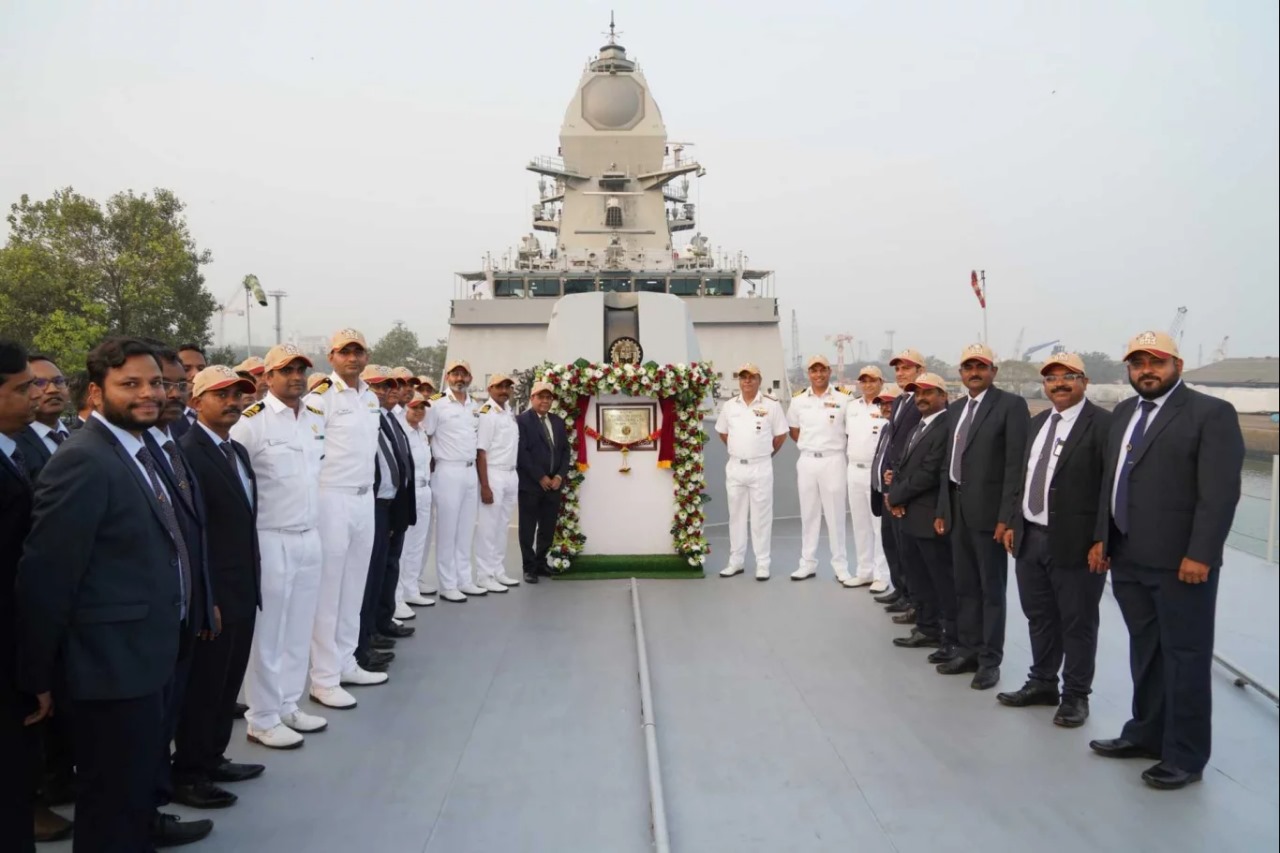
Indian Navy has taken Delivery of Taragiri, the Fourth Nilgiri Class Stealth Frigate.

Dec 2025 : The Indian Ministry of Defence have confirmed on November 29th, 2025, that Indian Navy has formally accepted its fourth Nilgiri class stealth frigate, designated Yard 12653, marking another major step in the seven-ship Project 17A program. Officials familiar with the handover described the event at Mazagon Dock Shipbuilders Limited as a visible sign of how India’s naval industrial base is maturing, with the new frigate set to join a class known for improved stealth shaping, updated sensors, and expanded mission flexibility across the Indo-Pacific.
The reincarnation of the original INS Taragiri, a Leander-class frigate that served from 1980 to 2013; the new Taragiri is a cutting-edge multi-mission warship engineered for surface, anti-air, and anti-submarine warfare. Built under the Indian Navy’s flagship P17A program, the ship embodies a generational shift in naval design, with a significantly reduced radar signature, high survivability standards, a network-centric architecture, and robust offensive capabilities.
Structurally optimised for stealth, the Taragiri incorporates an angular superstructure, flush-mounted sensors, and infrared suppression systems to reduce thermal and radar signatures. Below the waterline, a bulbous bow and low-noise propeller system enhance acoustic stealth and hydrodynamic efficiency, essential for submarine evasion and sonar stealth. The hull form is reinforced for high-speed performance and seakeeping, allowing the ship to maintain stability and combat effectiveness in rough sea states.
At the heart of Taragiri’s combat capability is an advanced integrated weapons suite. It is armed with the BrahMos supersonic surface-to-surface missile system capable of engaging enemy surface targets at ranges exceeding 290 kilometres with pinpoint accuracy. For air defence, the ship fields the MF-STAR (multi-function surveillance, track, and acquisition radar) paired with the vertical-launch MRSAM (Medium Range Surface-to-Air Missile) system, enabling the vessel to intercept aerial threats, including aircraft, drones, and sea-skimming missiles.
Its layered close-in defence system includes a 76mm Super Rapid Gun Mount (SRGM) for high-rate fire against air and surface targets, alongside twin 30mm automatic cannons and 12.7mm remote weapon stations for short-range threats. For anti-submarine operations, Taragiri is equipped with dual torpedo launchers, RBU-6000 rocket launchers, and a sophisticated hull-mounted sonar system, providing a potent undersea warfare punch and area denial capability in littoral and open-ocean environments.
The ship’s aviation facilities include a flight deck and hangar capable of operating an advanced naval helicopter such as the MH-60R or the indigenous HAL Dhruv. These airborne assets significantly enhance the ship’s surveillance reach, anti-submarine operations, and over-the-horizon targeting capability. Furthermore, the Integrated Platform Management System (IPMS) enables real-time diagnostics, automated power distribution, and damage-control management, enhancing survivability under combat conditions.
Driven by a Combined Diesel or Gas (CODOG) propulsion system, the Taragiri can sustain cruising speeds on diesel power and rapidly transition to high-speed sprint modes using gas turbines. This propulsion flexibility ensures efficient long-range patrols while allowing quick manouvering during combat. The ship’s endurance exceeds 5,500 nautical miles, allowing extended deployments across the Indian Ocean Region and beyond.
Mission-wise, Taragiri is configured to support a wide spectrum of operations, from high-intensity naval combat to peacetime maritime security missions such as anti-piracy, coastal surveillance, convoy escort, and humanitarian assistance or disaster relief.
The Taragiri is the fourth of seven P17A frigates, following INS Nilgiri, INS Himgiri, and INS Udaygiri. Its compressed build time of 81 months, down from 93 months for the lead ship, is credited to lessons learned from earlier vessels and more efficient integration practices. The remaining three ships, one at MDL and two at Garden Reach Shipbuilders and Engineers (GRSE), are on track for delivery by August 2026.
With over 75% indigenous content, the delivery of Taragiri is a strong declaration of India’s industrial maturity and defence capability. The ship’s entry into service will boost the Navy’s capacity to deter aggression, control key sea lanes, and project power into contested maritime zones, further solidifying India’s status as a regional security provider in the dynamic Indo-Pacific.
Team Maverick.






Japanese F-2 Fighter Reloaded With New Large Stealth Cruise Missile Under Its Wings.
Gifu Air Field, Kakamigahara City, Japan; August 2026: Yesterday (Friday – 31st July 2026)…
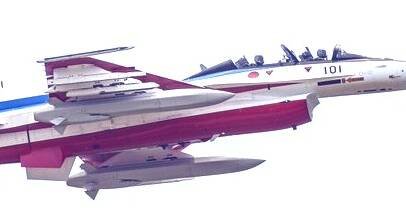
Japanese F-2 Fighter Reloaded With New Large Stealth Cruise Missile Under Its Wings.
Gifu Air Field, Kakamigahara City, Japan; August 2026: Yesterday (Friday – 31st July 2026) …