WTO Still At Large In Mitigating The Challenges Smaller Economies Face.

December 2025: A challenge for all WTO missions, and one felt most acutely by smaller and more resource constrained economies, lies in bridging the gap between the theory of what participation could look like and the practical steps required to realise it.
From a strictly legal standpoint, a World Trade Organization (WTO) member is obliged only to meet regular reporting and notification obligations, which can be fulfilled remotely from their capital and with the occasional in-person visit to Geneva.
However, there are innumerable opportunities to engage with the work being done at the organisation, from ongoing negotiations to specific trade concerns and the dispute settlement system; provided one has the resources and expertise to do so. This is an especially acute need at a time when multilateralism, and the WTO specifically, face considerable headwinds. Just as no one expected the United Nations Security Council to resolve the Cold War, it would be unreasonable to expect the WTO to halt these trends or resolve global tensions that drive most of them.
Yet the organisation does have a role to play in defense of the rules-based system and the benefits it provides, as a forum for comparatively depoliticised transparency and technical discussion around the implementation of measures, and as a platform to craft new rules in the areas where glimmers of consensus emerge. For the smallest and the most vulnerable economies, the WTO is often the only arena for them to engage in trade issues with a claim to some semblance of equal participation and voice.
It won’t be unrealistic to say that deploying even the most junior diplomatic attaché or Third Secretary to a WTO role in Geneva, which happens to be one of the most expensive cities in the world, can cost a government upward of US$200,000 (INR 1,80,00,000) per annum, or 1% of an entire ministry budget for a small Pacific island nation. The costs keep the staff profile of many missions modest and often vastly overstretched by both the WTO agenda and the often significantly broader responsibilities a mission in Geneva is tasked with. The city is home to more than 40 international organisations, many of which are member-driven and demand active representation. Moreover, being at the heart of Europe, many small developing countries accredit their Geneva representatives with remote bilateral ambassadorships to countries in the region.
Then there is the WTO agenda itself. Below is a screenshot of the official WTO agenda for the week at the time of writing:
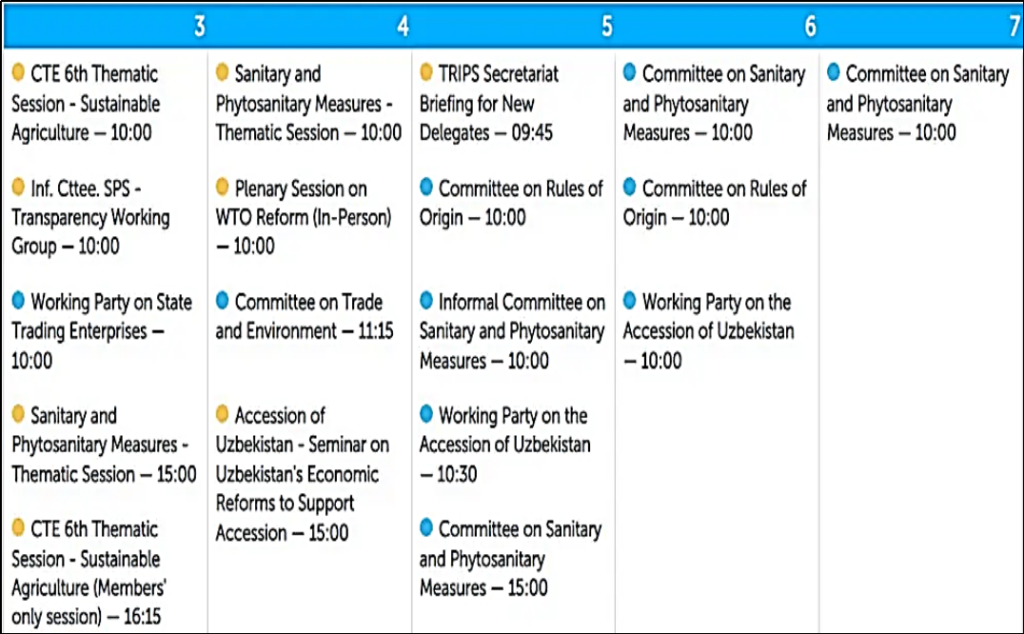
It is distinctively noticeable that on Wednesday, 05th November 2025, there are three committees occurring simultaneously, which also clash with an Accessions working party meeting and training for new delegates. So how would a small mission deploy its resources? Rules of Origin, the environment, and Sanitary and Phytosanitary are all areas of pressing concern to many developing countries.
The WTO Agreement on Trade-Related Aspects of Intellectual Property Rights, which governs intellectual property protection in areas including medicine, is a complex treaty on which training is beneficial. Accessions are one of the few ways the WTO has successfully improved aggregate market access, and an acceding member must have their goods offer signed off by all members, including developing ones.
Effective participation in any of these committees is time-consuming. So too is the process of consolidating hours of discussion into brief, accessible, relevant, and properly worded reporting back to colleagues in capital and around the world. Now consider that, as discussed above, the WTO is not the only intergovernmental organisation in town and likely not the only one the ambassador and his or her team are required to cover. Even with the support of the WTO Secretariat and membership of relevant groupings, small missions still lack human resources. This has implications for the skills each individual officer brings in a WTO context.
In practice, there is no clear distinction between developed and developing countries in the expertise of individual officers. The sheer variety of committees, processes, and negotiations a delegate at a small- to medium-sized mission may lead means that even those with expertise in one or two areas often find themselves starting from scratch in others. Further, operating effectively within the WTO framework requires on-the-job learning, including understanding the institution’s rhythms, building networks through interpersonal contacts, and gaining first-hand experience.
Developing missions often struggle in areas where resources of wealthier missions would ordinarily supplement delegate skill sets. A new delegate arriving in Geneva and stepping into a smaller team has fewer potential mentors. Fewer legal resources in-house make robust legal analysis of proposals or draft language challenging. In other words, what most separates developed from many developing country missions is not the skill level of their staff, but the systems, resources, and structures needed to support them.
Addressing need for time: The root cause of many problems is that developing country missions are often trying to do the work of 15 people with a team of just 03. The Aid for Trade community can help fund additional positions at post. If funding diplomatic officers from capital is unfeasible, financing locally engaged staff, assistants, or even interns can reduce the load on diplomatic officers and allow them to engage constructively.
At the work front there are innumerable tasks, from the mundane to the analytical that do not require a fully accredited diplomat, yet must be completed and otherwise fall to them. Where sufficient additional hands are not available to make light work, target the work itself. Much of WTO reporting is a combination of agenda monitoring and open-source research, which can be outsourced.
Addressing capacity: The support of donors and partners can replicate the network of expertise that a wealthier mission relies on to supplement the knowledge and experience of its in-country staff. In the long term, this can involve bringing on board either experts in WTO generally, like those currently assisting the African, Caribbean and Pacific (ACP) and Least-Developed Country (LDC) groups, or advisors on specific issue areas.
The challenge for small missions in Geneva is not the lack of theoretically available expertise, but in knowing where to find it, whether it is trustworthy, who to contact to access it, and managing the logistics required to arrange a session.
It is the need, not what is wanted: An inherent tension in donor funded capacity building and support for developing country missions lies in how the support aligns with the donor’s goals. Donors, including national aid budgets and private philanthropies, tend to be accountable for the delivery of their investments against certain strategic objectives.
Providing genuinely empowering support to developing country missions requires viewing multilateralism as inherently valuable, that it is not always easy to defend internally when making budgetary decisions. However, it should be defended, because providing capacity building is about lifting all boats.
The WTO and the system it underpins are stronger when developing countries are equipped to make use of its processes and resources. Irrespective of any broader reform conversation, addressing the constraints that hinder full participation by LDCs remains a priority for any donor or partner invested in the system’s long-term future.
Team Maverick.

Viren Rasquinha Questions India Hockey Team’s New Saffron Jersey
New Delhi, July 2026 : Former India hockey captain Viren Rasquinha has criticised Hockey I…

Viren Rasquinha Questions India Hockey Team’s New Saffron Jersey
New Delhi, July 2026 : Former India hockey captain Viren Rasquinha has criticised Hockey …