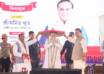
Omar Abdullah Sworn In as First Chief Minister of Jammu and Kashmir Union Territory

Omar Abdullah, Vice President of the National Conference (NC), was sworn in as the first Chief Minister of the Union Territory (UT) of Jammu and Kashmir. The oath-taking ceremony was held at the Sher-i-Kashmir International Convention Centre in Srinagar, where Lieutenant Governor Manoj Sinha administered the oath. This event marked a significant moment for the region, following the long-awaited elections held between September and October 2024.
Sakina Itoo, the sole woman minister in Abdullah’s cabinet, expressed her commitment to meeting the high expectations of the people. She acknowledged the formidable challenges ahead, stating, “It is a very challenging job right now because people have a lot of expectations. But we will try to meet those expectations and work for the people as much as possible.” Itoo emphasized the notable voter turnout, indicating that citizens reclaimed their democratic rights through participation in the elections. She pointed out the pressing issues that have plagued the region over the past decade, such as suppressed voices, underdevelopment, and significant challenges in sectors like power, health, and employment.
The ceremony was attended by prominent political figures, including Congress President Mallikarjun Kharge, Rahul Gandhi, Priyanka Gandhi Vadra, and leaders from the INDIA Bloc, such as Akhilesh Yadav and D. Raja. The Congress-National Conference alliance secured 48 seats in the Jammu and Kashmir assembly elections, with the NC winning 42 seats and Congress securing six.
Before the ceremony, Abdullah paid his respects at the revered Hazratbal shrine and Qaid Mazar in Naseem Bagh, where he offered prayers and honored his grandfather, Sheikh Abdullah, the founder of the Jammu and Kashmir National Conference. Notably, he donned a black knee-length jacket, reminiscent of the traditional Achkan worn by his grandfather.
During the high-profile event, Abdullah made a solemn pledge to uphold confidentiality regarding matters brought before him as Chief Minister. Alongside him, five cabinet ministers were sworn in, though no representatives from the Congress party were included. After taking the oath, Abdullah inspected his first guard of honor at the civil secretariat and chaired his first meeting of administrative secretaries. He later posted a photo of himself in the Chief Minister’s chair, which had been vacant since the fall of the PDP-BJP government in 2018, declaring, “I am back.”
While Abdullah appeared jubilant, his father, Dr. Farooq Abdullah, referred to his son’s leadership as a “crown of thorns.” Farooq expressed his hope that Allah would help Omar fulfill the expectations of the people. In light of the recent election results, Omar Abdullah announced that the new J&K assembly would pass a resolution demanding the restoration of statehood to Jammu and Kashmir, although former New Delhi Chief Minister Arvind Kejriwal described the region as a “half-state” and offered his support, suggesting that Omar consult him for advice on managing it.
Political analysts indicate that governing an assembly that was once among the most powerful in the country, now one of the weakest, will present considerable challenges. Among the pressing issues, rising electricity tariffs loom large, but the new government currently lacks the authority to address them. The JKNC’s manifesto promises to provide 200 units of free electricity to the residents of J&K.
Immediately upon assuming office, Omar Abdullah instructed the J&K police chief to cease the practice of stopping traffic during his movements, which has long caused significant inconvenience and affected public mental health. He also directed that aggressive gestures and the use of sticks against citizens be avoided during his commutes, measures that have been welcomed by the public.
Messages of congratulations poured in from various local and national leaders, with many expressing hope that Omar would restore J&K’s dignity and address ongoing issues faced by residents. PDP patron Mehbooba Mufti congratulated him, wishing that the new government would “heal the wounds of the J&K people” resulting from decisions made in August 2019. Meanwhile, JKNC MP Aga Ruhullah Mehdi emphasized the challenge of fulfilling the political aspirations of the people while maintaining effective governance.
In its manifesto titled “Dignity, Identity, and Development,” the JKNC pledged to strive for the full implementation of the Autonomy Resolution passed by the Jammu and Kashmir Assembly in 2000 and to amend laws enacted after August 2019 that affect J&K’s special status. Owais Bhat, a history scholar, noted, “While they may not achieve everything promised, the people of Kashmir now have a barrier between them and New Delhi.”


Telangana’s Abhi Chandra Clinches Two Medals at Special Olympics Nationals
Dehradun, July 2026 : Determination, discipline and an unyielding passion for sport define…

Telangana’s Abhi Chandra Clinches Two Medals at Special Olympics Nationals
Dehradun, July 2026 : Determination, discipline and an unyielding passion for sport defined the …