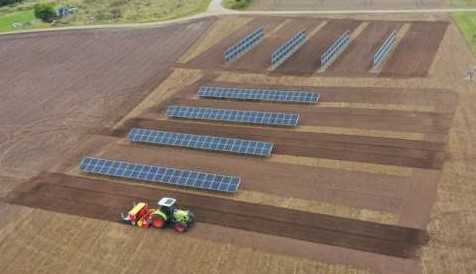
Vertical solar panels and crops thrive side by side demonstrating a Double Harvest.

Sept 2025 : The combined use of land for agriculture and photovoltaic electricity production (agrivoltaics) is well proving to be a strategy to capture benefits for both crops and solar panels. Researchers from Aarhus University has carried out an in-depth exploration of an 89-kW pilot system comprising vertically mounted and south-oriented tilted bifacial solar panels in Denmark (latitude 56.5⁰).
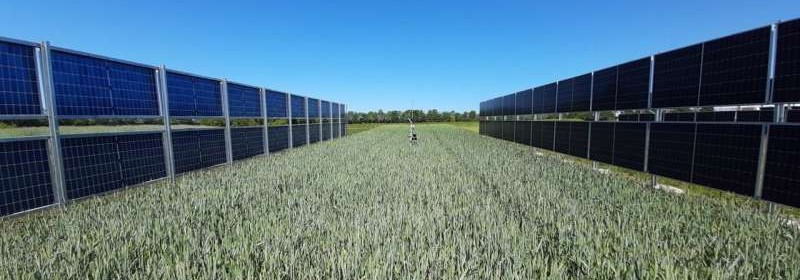
Variables including microclimate and electricity production were measured for one year, together with the yield of wheat and grass-clover mixture grown between the rows of solar panels. Both vertical and tilted agrivoltaic systems result in a positive land equivalent ratio, that is, for the same output they use less land area than would be required if the crops and the solar panels were on different lands. The vertical solar panels acted as wind shelters and their daily profile for electricity generation matches electricity demand better. In addition, our social acceptance study highlights that vertical agrivoltaic systems were perceived more positively than conventional solar panels. Their results offer a strategy for the sustainable integration of solar electricity generation and agriculture in temperate climates, that wheat and grass-clover mixtures grow just as well between vertical solar panels as in open fields. At the same time, the panels produce electricity in a daily pattern that better matches energy demand.
At the test site in Foulum, researchers installed two types of bifacial solar panels: one traditional, south-facing tilted system, and one vertical, east-west-facing system. The vertical panels produce slightly less electricity per year, but with higher value, as generation peaks coincide with morning and late afternoon demand.
At the same time, crops growing among the vertical panels showed no decline in yield.
“Even with some shade, the yield per square meter is almost the same. The crops don’t seem to mind the presence of solar panels and they like the wind protection that they provide“, explained Professor Uffe Jørgensen from the Department of Agroecology, Aarhus University. Because the panels only occupy about 10% of the field area, the combined system requires much less land than separate installations. “If we were to produce the same amount of electricity and food using separate land, we would need 18–26% more area“, the researchers highlighted.
The vertical configuration comes with added technical and environmental benefits. The bifacial glass-on-glass panels require fewer materials, have lower CO₂ emissions, and reduce wind loads, all while maintaining compatibility with standard farming equipment. But it’s not just the crops and climate that benefit.
To assess how these systems are perceived, the research team conducted an immersive virtual reality (VR) study involving over 100 participants. The result: Vertical agrivoltaics were rated significantly more positively than conventional solar parks. “Participants liked the vertical panels better, especially up close, when they saw the land was still farmed. They also perceived vertical agrivoltaics as more innovative and environmentally friendly than conventional solar parks“, says Gabriele Torma, assistant professor at the Department of Management, Aarhus University. Unlike conventional systems, which can appear flat and industrial, the vertical panels resemble modern hedgerows—blending into the landscape rather than disrupting it.
Requisite Land Equivalent Ratio (LER) calculation –
Land Equivalent Ratio (LER) is defined as the land area that would be needed under mono-crop cultivation systems (in our case if the crops and the PV system were on different lands) to produce the same yield as the APV system. The LER equation combines three components (i) annual crop yield, (ii) annual PV electricity generation, and (iii) land loss from the area occupied by the solar panels. LER can be calculated as:

Where Crop YieldAPV and Crop YieldOF represent the annual crop yields of the agrivoltaic system and the reference open-field area, respectively, both measured in tons per hectare (t/ha). Total Land Area is the total area of land considered in the analysis, measured in hectares, while LLAPV denotes the land loss due to solar panels and their supporting structures, also measured in hectares. Energy OutputAPV refers to the annual electricity generation from the vertical agrivoltaic system, measured in MWh/ha, and Energy OutputREF represents the annual electricity generation from the reference PV system (MWh/ha), in which land is solely occupied by solar panels. To calculate the land loss, a 2 m and 3 m strip was considered to be not useful to agriculture for the vertical and south-oriented solar panels, respectively. As mentioned in Willockx et al., the land loss due to solar panels and supporting structures is not a real loss since we used it as biodiversity strips seeded with low indigenous herbs.
Team Maverick






Delivery Of Second Indigenous Diving Support Vessel – ‘Nipun’
‘Nipun’ the second Diving Support Vessel (DSV), built by Hindustan Shipyard Limited&n…

Delivery Of Second Indigenous Diving Support Vessel – ‘Nipun’
‘Nipun’ the second Diving Support Vessel (DSV), built by Hindustan Shipyard Limited was delivered to the …