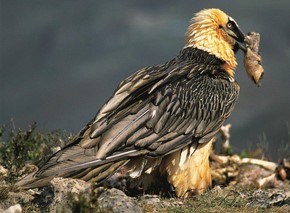
The Bearded Vulture as an accumulator of historical remains, their nests found to have hoards of cultural artifacts, ageing 650 years old.

Oct 2025 : Territorial raptors typically occupy their territories over long periods of time. Since usable nest sites are valuable resources for raptors and serve a signal function for conspecifics of habitat quality, long-term nest reuse over decades and centuries can be usual for some species.
Analyses of faecal material accumulated in a Gyrfalcon (Falco rusticolus) eyrie in Greenland demonstrated that it had been occupied for at least 2500 years. Similarly, an analysis of the twigs in a Golden Eagle (Aquila chrysaetos) nest in western North America showed that it had been constructed more than 500 years ago. The records of 19th and early 20th century ornithologists also record cases of long-term nest occupancy. Based on information obtained from the literature, the long-term occupancy (1900–2015) of an Egyptian Vulture (Neophron percnopterus) nest in the Canary Islands.

Most vulture species breed on cliffs and carry food to the nest for their chicks in their crop. However, some species such as the Bearded Vulture (Gypaetus barbatus) and the Egyptian Vulture mainly use their beaks to carry food, and Bearded Vultures also sometimes use their talons. In the case of cliff-nesting species, their well-protected eyries situated in cliff caves, rock shelters, or on cornices allow the accumulation of food remains in the eyries, as well as natural or anthropogenic material used to build the nest.
The Bearded Vulture is the most threatened vulture in Europe, with only 309 breeding pairs, 144 of which are in the Pyrenees. However, during the 19th century, the species was distributed in all of the mountainous areas of the Iberian Peninsula and other European mountains. Its nest sites are characterised by having microclimatic conditions that allow both the accumulated bone remains delivered to the nest to feed the chick and the material used to build the nest to remain in good condition. Pieces of cloth, string, and other anthropogenic manufactured material used to cover the nest bowl for thermoregulatory purposes during incubation are regularly observed in contemporary nests. Feeding ecology can be studied by examination of the accumulated bone, feather, skin, and hair remains in nests as well as the occurrence of anthropogenic material. The study of the material preserved in caves housing ancient Bearded Vulture nests can therefore provide interesting information not only about the feeding ecology of the species but also about historical ethnographic and biocultural conditions.
Over a decade ago, a group of researchers in Spain had the opportunity to examine 12 of these nests in detail. Between 2008 and 2014, they have carried out intense research focusing on more than 50 well-preserved historical Bearded Vulture nests in parts of southern Spain, where the species became extinct around 70–130 years ago. A total of 12 nests were examined, and the remains were identified and analysed layer by layer, following established archaeological stratigraphic methods.
The findings were spell bounding, as we depict the factuality hereunder:
The team rifled through centuries worth of vulture eggshells, remains of prey, and nesting material and among these they also found 226 items that had been made or altered by humans, those which provide a window into both past ecosystems and human cultures from the region. The hoard included items like a slingshot made from esparto grass, shoes, a crossbow bolt, a decorated piece of sheep leather and a wooden lance.
Even more surprising was that several items were well over 600 years old, according to carbon-14 dating. Results from one shoe dated back to around 675 years ago, while the decorated leather dated to around 650 years ago. However, the dating revealed a range of time periods, with a piece of basket dating to about 150 years ago.
Largely due to the strengthening Bearded Vulture nest structures and their locations in the western Mediterranean, generally in protected places such as caves and rock shelters with relatively stable temperature and low humidity conditions, they have acted as natural museums, conserving historical material in good condition.
In addition to the human-made items, the researchers found 2,117 bones, 86 hooves, 72 leather remains, 11 hair remains and 43 eggshells. The team notes that this study and its findings “can provide information about temporal changes in the trophic spectrum, past environment, and the wild and domestic species present. The researchers have attributed these nests a powerful tool for investigating and understanding more about the ecology, biodiversity trends, and environmental changes that the vultures are subject to. The findings could potentially inform habitat restoration and species reintroduction efforts.
Therefore, from an ecological perspective, the stratigraphical approach can provide information about temporal changes in the trophic spectrum, past environment, and the wild and domestic species present. Nest accumulations along elevation gradients represent a powerful tool for investigating avian ecology, biodiversity trends, and environmental change. More interestingly, the abundant and well-preserved anthropogenic elements brought to the nests, such as the extraordinary historical manufactured items made of esparto grass: such as alpargatas (esparto sandals) have an ethnographic interest. These artifacts can gain significance when considered alongside nest altitude, which influences the availability of remains and the type of ecological zone represented. Extraordinary findings were made, such as several ancient agobías (rough footwear made of several species of grass and twigs) and the crossbow bolt. Similar sandals and basketry artifacts related to the first farming communities were identified related to the Neolithic occupation of Los Murciélagos cave in nearby Granada which is 35 kilometres away.
In addition, these findings have wider relevance for other disciplines, such as ethnobiology and archaeology. For example, the pollen, animal bones, and tree twigs and branches found in ancient nests could provide the basis for chronological and past environmental reconstructions, while the ethnographic and archaeological material could inform studies of ancient human artifacts and provide information on the biocultural heritage of specific mountain areas.
Team Maverick








Delivery Of Second Indigenous Diving Support Vessel – ‘Nipun’
‘Nipun’ the second Diving Support Vessel (DSV), built by Hindustan Shipyard Limited&n…

Delivery Of Second Indigenous Diving Support Vessel – ‘Nipun’
‘Nipun’ the second Diving Support Vessel (DSV), built by Hindustan Shipyard Limited was delivered to the …