The Uprise of Nuclear Proliferation since 2014, and its Future Trajectories.

Since 2014, Russia has launched a campaign of land grabbing and, since 2022, an invasion with genocidal characteristics on Ukrainian territory. As a former Soviet republic, Ukraine was a founding member of the United Nations in 1945. It has been an official non-nuclear-weapon state under the Non-Proliferation Treaty (NPT) since 1996.
For over three years, politicians and strategists from other revanchist powers have observed the course of Russia’s attack and gauged the reactions of other states and international organizations. Relatively weaker countries are learning from Ukraine’s experience that they cannot rely on international law, organizations, and solidarity, and they should not make the mistake, as Kyiv did, of trusting “security assurances,” “guarantees”, “friendship treaties”, “strategic partnerships”, and the like. Such agreements are of little significance, as demonstrated by the irrelevance of Ukraine’s respective agreements with Russia (1994, 1997), China (2013), and the United States.
The Machiavellianism of the three most powerful countries in the world, China, the United States, and Russia, are detrimental to the core objectives of the Non Aligned Movements – the national independence, sovereignty, territorial integrity and security of non-aligned countries in their struggle against imperialism, colonialism, neo-colonialism, racism, and all forms of foreign aggression, occupation, domination, interference or hegemony as well as against great power and bloc politics.
Since its foundation, the People’s Republic of China (PRC) has expressed interest in Taiwan, and on the verge of attempting to conquer the island. Somewhat less seriously, in January, the newly inaugurated President Donald Trump announced his intention to incorporate Canada and Greenland into the United States.
The less powerful nations prefers to join defensive alliances with substantial warheads to mitigate their security concerns, but as Georgia and Ukraine, among others, have learned the hard way, gaining full membership in a powerful defence alliance is neither easy nor risk-free. In a response to Georgia and Ukraine’s applications for NATO membership in April 2008, NATO had urged both the nations to become members.
What followed, however, was neither their accession to NATO nor the start of a process of admission to the alliance, the Membership Action Plan (MAP). Instead, Georgia has been dismembered by Russia since 2008 and Ukraine since February 2014. The only consolation for the two countries may be that Moldova, also a post-Soviet republic, but a constitutionally neutral state with no ambitions to join NATO, has also been dismembered by Russia for more than 30 years. The fate of Finland, which has a long border with Russia, serves as a counterexample: Unlike Georgia and Ukraine, Finland successfully initiated a NATO accession process in 2022, culminating in its accession in 2023.
The harsh realities of Finland and Moldova show that a former Russian colony’s intention to join NATO is neither a sufficient nor a necessary condition for the Russian to deter from invasion. Both Georgia and Ukraine have become targets of Russian expansionism, like Moldova.
Russia’s illegal seizure of the Crimean Peninsula from Ukraine in March 2014 was unprecedented and bloodless, marking Russias relations with the West into a downward spiral unseen since the Cold War.
In 2013-14, a massive popular uprising gripped Ukraine for weeks, eventually forcing pro-Russia President Victor Yanukovych from office. Amid the turmoil, Russian dictator Vladimir Putin pounced, sending armed troops without insignia to overrun Crimea.
Putin later called a referendum in Crimea to join Russia that Ukraine and the West dismissed as illegal.
Immediately, Russia’s relations with the West plummeted to new lows. The United States, the European Union, and other countries imposed sanctions on Russia and its officials.
Russia’s illegal annexation of Crimea on March 18, 2014, was recognised only by countries such as North Korea and Sudan. In Russia, it touched off a wave of patriotism, and “Krym nash! — Crimea is ours!” — became a rallying cry. The move sent Putin’s popularity soaring. His approval rating, which had declined to 65% in January 2014, shot to 86% in June, according to the Levada Center, an independent Russian pollster. Putin has called the peninsula “a sacred place” and has prosecuted those who publicly argue it is part of Ukraine, particularly the Crimean Tatars, who strongly opposed the annexation. What is mention worthy that the annexation had encouraged Vladimir Putin for Russia’s full-scale invasion of Ukraine in 2022, during which Russia had illegally annexed more land from its neighbour. A look at the diamond-shaped peninsula in the Black Sea, coveted by both Russia and Ukraine for its naval bases and beaches.
Crimea’s unique location makes it a strategically important asset, and Russia has spent centuries fighting for it. The peninsula was home to Turkic-speaking Tatars when the Russian empire first annexed it in the 18th century. It briefly regained independence two centuries later before being swallowed by the Soviet Union.
Soviet leader Nikita Khrushchev transferred Crimea from Russia to Ukraine in 1954, when both were part of the USSR, to commemorate the 300th anniversary of the unification of Russia and Kyiv. In 1991, when the Soviet Union collapsed, the peninsula became part of newly independent Ukraine.
Russia kept a foot in the door, however: Its Black Sea Fleet had a base in the city of Sevastopol, and Crimea — as part of Ukraine — continued to host it. By the time Russia annexed it in 2014, it had been within Ukraine for 60 years and was part of the country’s identity.
Ukrainian President Volodymyr Zelenskyy has vowed to retake it and said Russia “won’t be able to steal” the peninsula. For either side, possession of Crimea is key to control over activities in the Black Sea — a critical corridor for the world’s grain, among other goods.
Ahead of its full-scale invasion, Russia deployed troops and weapons to Crimea, allowing Russian forces to quickly seize large parts of southern Ukraine early in the war. A top Russian military official later said that securing a land corridor from Russia to Crimea by holding the occupied parts of Ukraine’s Donetsk, Luhansk, Zaporizhzhia and Kherson regions was among the key goals of what the Kremlin called its “special military operation” in Ukraine.
Before the invasion, Zelenskyy focused on diplomatic efforts to get Crimea back, but after Russian troops poured across the border, Kyiv began publicly contemplating retaking the peninsula by force.
After the annexation, fighting broke out in eastern Ukraine between pro-Kremlin militias and Ukrainian forces. Russia vouched its loyalty from the insurgents, even though it denied supporting them with troops and weapons. There was abundant evidence to the contrary, including a Dutch court’s finding that a Russia-supplied air defence system shot down a Malaysia Airlines passenger jet over eastern Ukraine in July 2014, killing all 298 people aboard.
Russian hard-liners later criticised Putin for failing to capture all of Ukraine that year, arguing it was easily possible at a time when the government in Kyiv was in disarray and its military in shambles. The fighting in eastern Ukraine continued, on and off, until February 2022, when Putin launched a full-scale invasion of Ukraine.
Team Maverick

Govt. to formulate policy to provide relief in encroachment cases involving poor and landless families: CM
Chief Minister Thakur Sukhvinder Singh Sukhu today laid the foundation stone of the new Mu…
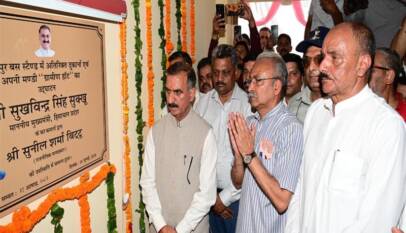
Govt. to formulate policy to provide relief in encroachment cases involving poor and landless families: CM
Chief Minister Thakur Sukhvinder Singh Sukhu today laid the foundation stone of the new …