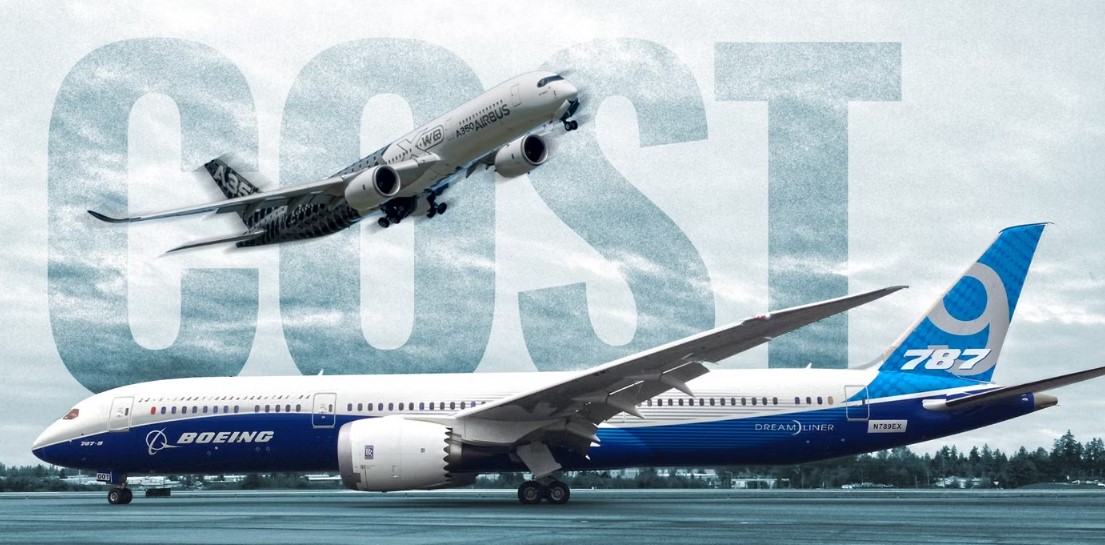
Boeing 787 Versus Airbus A350.

When choosing which Jet to go for, airlines have to consider their commercial viability. This judgment includes comparing each aircraft’s list prices, alongside their standard operating costs.
Comparing the List Prices –
The A350 has two variants, the A350-900 and the longer A350-1000. The -900 has a list price of $317 million. Meanwhile, the A350-1000 has a list price of $367 million.
Two of the three Boeing 787 Dreamliner variants are substantially cheaper. The list price for the smallest variant, the 787-8, is $248 million; the middle-sized variant has a list price of $292 million; the largest variant, the 787-10, has a list price of $338 billion which is between the A350-1000 and the A350-900.
Comparing the Charter Cost –
Purchasing an aircraft is not the only way that it can be flown. Private owners and airlines can also choose to charter the jets from business jet and charter service providers. Paramount Business Jets estimates that the average cost of chartering a Boeing 787 is $30,950 an hour. As with purchasing the aircraft, the costs will be higher for those chartering the larger variants. Other business aviation services, such as premium cabin crew and inflight refreshments, will also push this cost higher.
This table compares key specifications of variants from the two widebody families that have similar purchasing costs: 787-9 and A350-900:

An estimate was drafted for the costs of chartering an Airbus ACJ350, which is the business jet version of the A350, for which an outright purchase will cost $300-$375 million. The chartering costs is $30,000-$40,000 an hour, depending on the selected provider and other factors. This cost includes a chartering fee of $7,000-$8,000 per hour, plus an operating cost of $15,000-$20,000 per hour. Also the constituents of this price are fuel, crew salaries, insurance, and other miscellaneous costs.
Operating Costs Per Seat –
When a carrier assesses the commercial viability of an aircraft, it doesn’t only consider the purchase cost. The purchase cost is much lesser for the old and second-hand aircraft, but such jets come with much higher operating costs, as they are inefficient and require constant and expensive upkeep. Modern jets, including the Airbus A350 and 787, are more commercially viable because they have comparatively low operating seat costs per hour. As with purchasing and chartering prices, operating costs are usually higher for larger, higher-capacity variants. However, this can be offset by the higher capacity, which spreads the cost across more seats.
The operating cost for a 787 Dreamliner’s smallest variant is $30 per seat hour. This is the highest per seat cost of the Dreamliner variants. The Boeing 787-9, the most popular variant, comes in at $25.86 per seat hour. This is a little higher than the Airbus A330-900, $22.43, which is often considered the aircraft that the 787-9 competes with most directly. Finally, the Boeing 787-10 has the lowest cost per seat at $19.54 an hour.
The A350 has comparable operating costs, by the virtue of its advancements in fuel efficiency. Airbus claims that the A350’s fuel burn is 25% lower than that of its nearest competitors. Likewise, the jet offers a range improvement of 34.8% on the 777-200 and 25% lower maintenance costs than the 777 family. The operating cost per seat comes in at $22.81 per seat hour. This is substantially lower than all variants of the Boeing 787 Dreamliner apart from the 787-10.
Other costs which are larger than expected –
The costs of aircraft ownership and maintenance are usually only around 20% of an airline’s overall operating costs. Many of the other costs are beyond the aircraft itself. Certain unexpected costs are “airport and navigation” (8% of overall operating costs), total distribution (6%), and passenger services (5%). Total distribution costs mean the fees paid to travel agents and third-party booking platforms that help airlines sell tickets.
Another significant cost is paying staff salaries and meeting their training needs. Salaries are often negotiated with unions or based on pay bands tied to experience, so airlines often have little way of reducing these costs. Benefits, such as pension contributions and bonuses, add further costs. Automating certain tasks, such as the check-in process, has allowed some airlines to reduce costs. Training costs, particularly for pilots, cabin crew, and ground engineers, are more related to an airline’s choice of aircraft. Ensuring that the fleet is focused on a particular type of aircraft or manufacturer ensures a greater degree of commonality and reduces the need to retrain staff.
With cognizance to the costs more commonly associated with aviation, some airlines have been able to improve their profit margins by getting a bit creative. One example is “fuel hedging” – a practice of buying large quantities of fuel when the price drops. Airlines have to be vigilant as increased demand pushes price surge. Delta Air Lines managed to be more creative, by acquiring a oil refinery.
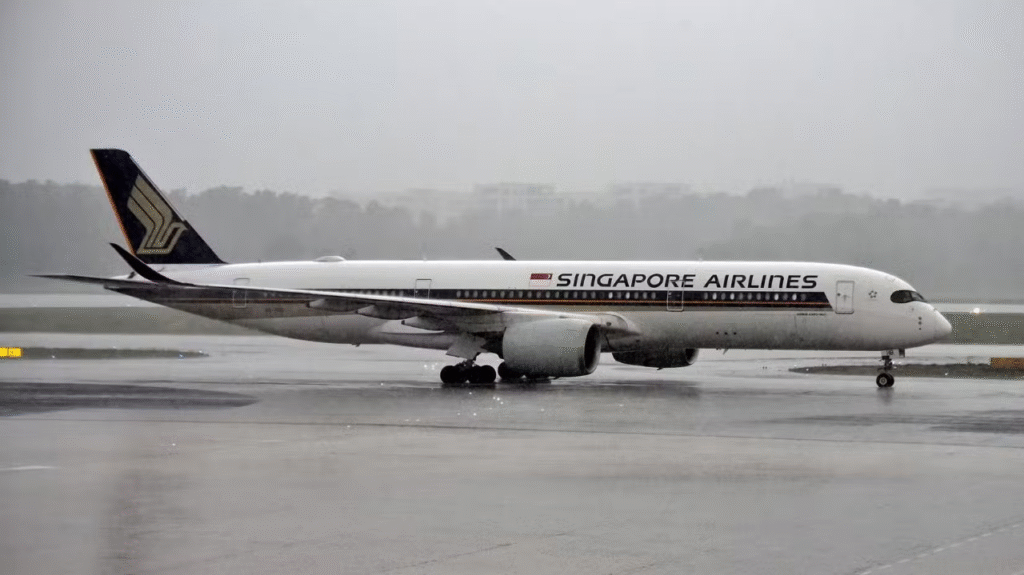
Singapore Airlines benchmarked its A350 Operating Costs –
One way Singapore Airlines reduces its A350 costs is by ensuring it is being utilised in the most economically efficient way. The A350 performs best on high-yield long-haul routes, where its fantastic fuel efficiency and unmatched range can deliver. Meanwhile, carriers using the A350 for shorter routes have to deal with much higher costs per seat. Singapore also focuses on its premium services aboard the A350 to enhance the revenue it can make per seat.
Having such a huge fleet of A350s also brings opportunities to reduce costs. It allows for fantastic fleet commonality. The carrier has been able to standardise its pilot training and maintenance procedures while maintaining an impressive spare parts inventory. This means less time is wasted while the aircraft is repaired, and pilots can stay in the skies without having to undergo unnecessary training programs.
Conclusion –
A Boeing 787 Dreamliner is usually a cheaper aircraft to purchase. All variants are cheaper than the A350-1000, and only the Boeing 787-10 is more expensive than the A350-900. However, some costs are close enough that well-brokered deals can make an A350 cheaper than the list price of a 787.
However, the purchase price is just one cost carriers need to consider when purchasing an aircraft. Airlines also pay a vast amount for operating and maintenance costs. The A350 had its first flight four years after the 787 Dreamliner, indicating that it benefits from slightly more recent technology. As a result, the highly efficient A350 generally has lower operating costs than the Dreamliner, with the outlier being the high-capacity 787-10.
The other miscellaneous costs detailed in this article are difficult to pin down and are only tangentially connected to the aircraft themselves. These costs will vary greatly depending on the region and measures taken by the carrier to reduce them.
Team Maverick








PM Modi, Australian Opposition Leader Angus Taylor Reaffirm Bipartisan Commitment to Stronger India-Australia Ties
Melbourne, July 2026 : Prime Minister Narendra Modi on Friday met Australian Opposition Le…

PM Modi, Australian Opposition Leader Angus Taylor Reaffirm Bipartisan Commitment to Stronger India-Australia Ties
Melbourne, July 2026 : Prime Minister Narendra Modi on Friday met Australian Opposition Leader …