New Labour Laws Aim to Drive Inclusive Growth, Extend Social Security to Gig Workers and Women

New Delhi, Nov 22: The government on Saturday said that India’s newly implemented labour laws are designed to ensure inclusive growth and extend comprehensive social security to gig workers, women, and other vulnerable segments of the workforce. The reforms, it added, will significantly enhance workforce participation and support the country’s long-term development goals.
India has experienced a substantial transformation in its regulatory framework with the rollout of four consolidated Labour Codes— the Code on Wages, 2019; the Industrial Relations Code, 2020; the Code on Social Security, 2020; and the Occupational Safety, Health and Working Conditions Code, 2020. Together, they aim to streamline labour regulations, expand protections, and modernise employment standards for a rapidly evolving economy.
According to the government statement, the Code on Social Security, 2020 marks a pivotal step in extending welfare coverage to previously unprotected labour groups. It “reflects the government’s commitment towards inclusive growth and social security for all, in line with the vision of a Viksit Bharat by 2047,” the statement said.
For the first time, the Social Security Code formally recognises gig and platform workers, acknowledging their growing economic contribution in sectors such as ride-hailing, delivery services, app-based freelancing, and e-commerce logistics. The Code provides for the creation of a dedicated Social Security Fund to support these workers.
Under Sections 113 and 114, unorganised, gig, and platform workers become eligible for a range of benefits, including life insurance, disability cover, health and maternity protection, and provident fund schemes. A National Social Security Board will also be established to advise the government on designing, implementing, and reviewing welfare schemes tailored to the specific needs of workers in informal and digital-platform sectors.
The new laws further expand the reach of EPFO (Employees’ Provident Fund Organisation) and ESIC (Employees’ State Insurance Corporation) nationwide, bringing a greater number of establishments and workers under formal social security systems. The Social Security Code consolidates nine existing laws into a single, simplified framework to ensure universal and uniform protection across organised, unorganised, gig, and platform sectors.
One of the most progressive features of the new Code is its comprehensive focus on women workers’ welfare. It provides 26 weeks of maternity leave, extending equal wages during the leave period for women who have worked at least 80 days in the preceding 12 months. Additionally, women who adopt a child below three months or commissioning mothers (biological mothers using surrogacy) are entitled to 12 weeks of maternity benefit.
To support women returning to work postpartum, the Code introduces flexible options such as work-from-home, where feasible, through mutual agreement between employer and employee. The legislation also mandates nursing breaks, allowing two breaks daily for breastfeeding until the child is 15 months old.
Moreover, establishments with 50 or more employees must provide a crèche facility within a prescribed distance. Importantly, this requirement is now gender-neutral, ensuring that both male and female employees with young children benefit from childcare support.
The reformed labour framework also prioritises ease of doing business, featuring measures such as digital record-keeping, decriminalisation of minor offences, compounding provisions, and a transparent, technology-enabled inspector-cum-facilitator system—elements that aim to foster compliance without burdening businesses.
Overall, the new labour codes represent a major step toward building a more equitable, secure, and modern workforce, and form a key pillar of India’s ambition to achieve holistic and inclusive development by 2047.
The Code on Social Security, 2020 (SS Code, 2020) consolidates and simplifies nine central labour laws relating to social security. Its main goal is to extend social security benefits to all employees and workers, including those in the unorganised, gig, and platform economy.
Key provisions:
- Laws Merged
The following Acts stand repealed and merged into the Code:
Employees’ Compensation Act, 1923
Employees’ State Insurance Act, 1948
Employees’ Provident Funds and Miscellaneous Provisions Act, 1952
Employment Exchanges (Compulsory Notification of Vacancies) Act, 1959
Maternity Benefit Act, 1961
Payment of Gratuity Act, 1972
Cine Workers Welfare Fund Act, 1981
Building and Other Construction Workers’ Cess Act, 1996
Unorganised Workers’ Social Security Act, 2008
- Wider Coverage
Extends social security benefits to employees in the organised sector, unorganised sector, self-employed, and for the first time, gig workers and platform workers.
- Social Security Schemes
Central and State Governments can frame schemes covering:
Provident fund and pension
Employees’ State Insurance (health, disability, accident cover)
Gratuity
Maternity benefits
Other benefits such as life cover, old-age protection, and crèche facilities
- Provisions for Unorganised, Gig, and Platform Workers
Gig and platform workers (e.g., app-based workers) are recognized in the Code.
They are eligible for social security schemes funded by government, aggregators/platforms, and sometimes the workers themselves.
Setting up of Social Security Fund to support such workers.
The Code also has a provision to constitute a National Social Security Board to look after the welfare of gig and platform workers.
(The content of this article is sourced from a news agency and has not been edited by the Mavericknews30 team.)



Rahul Gandhi, INDIA Bloc Hold Candlelight Vigil at Gandhi Smriti Over NEET Paper Leak Row
New Delhi, July 2026 : The Opposition intensified its campaign over the alleged NEET exami…
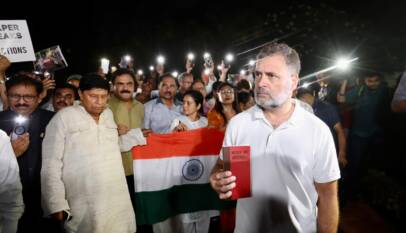
Rahul Gandhi, INDIA Bloc Hold Candlelight Vigil at Gandhi Smriti Over NEET Paper Leak Row
New Delhi, July 2026 : The Opposition intensified its campaign over the alleged NEET …