
Scientists turn bacteria-infused cement into energy-storing supercapacitors.

Sept 2025 : A research team at Aarhus University, Denmark has demonstrated how the world’s most widely used building material ‘Cement’ can be transformed into a living energy device. By embedding energy-producing bacteria in cement, they have created a biohybrid supercapacitor with surprisingly high performance and a remarkable ability to regenerate itself over time.
“We’ve combined structure with function“, says lead researcher Qi Luo. “The result is a new kind of material that can both bear loads and store energy, and which is capable of regaining its performance when supplied with nutrients”.
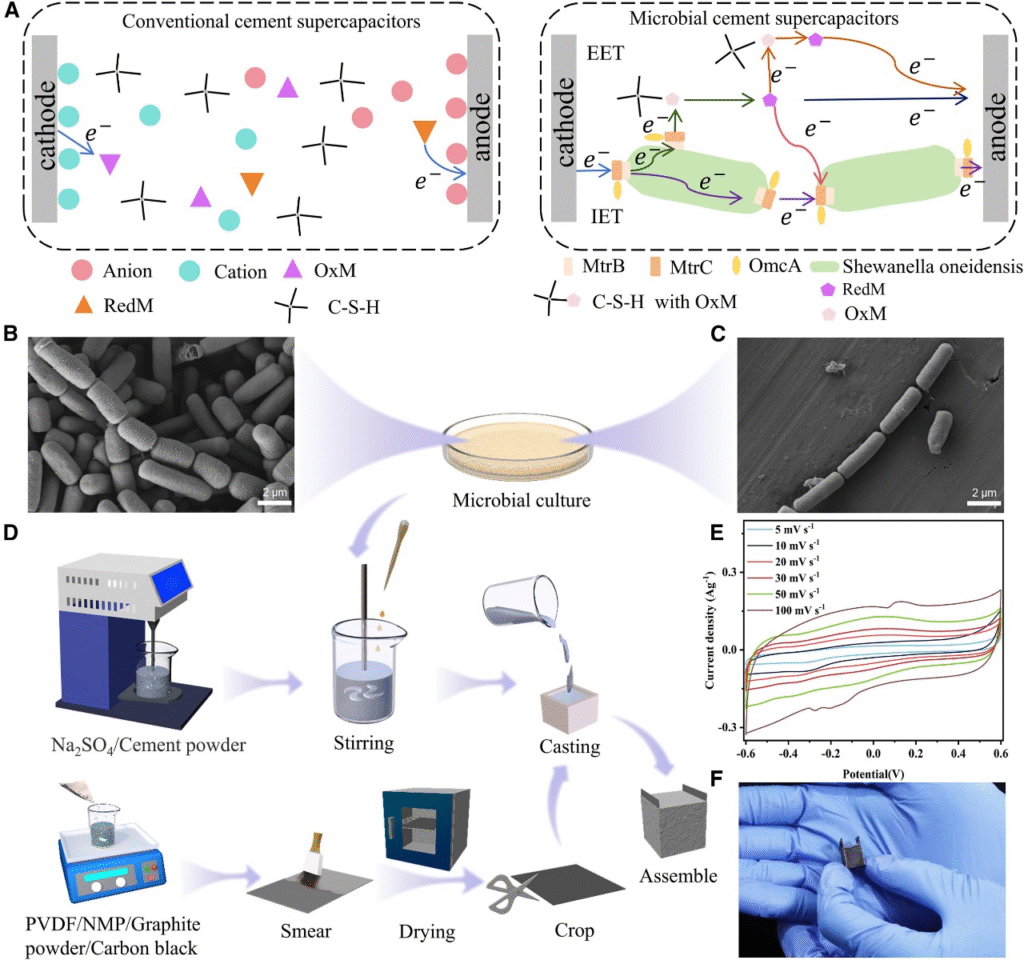
Concrete has long been seen as inert and lifeless. But this new study, just published by the team in the journal Cell Reports Physical Science, takes a radically different approach: They add “Shewanella oneidensis”, a bacterium known for its ability to transfer electrons to external surfaces via so-called extracellular electron transfer. Once embedded in the cement matrix, these bacteria create a network of charge carriers capable of both storing and releasing electrical energy. Even at this early stage, the material already shows performance well beyond what traditional cement-based energy storage systems have achieved, suggesting promising potential for future development.
But what’s perhaps most striking is that the material continues to function even after the microbes have died, and that it can be brought back to life.
Because microbial activity gradually fades due to nutrient depletion or environmental stress, the researchers designed an integrated microfluidic network within the cement that can deliver a nutrient solution containing proteins, vitamins, salts and growth factors to keep the bacteria alive or “reawaken” the system. With this method, up to 80% of the original energy capacity can be recovered.
In practical terms, this opens the door to recoverable energy materials that maintain their function over time, without the need to replace batteries or perform costly repairs.
The researchers also stress-tested the material under challenging conditions. Even at freezing temperatures and at elevated heat, the cement retained its ability to store and discharge electricity. And when six cement blocks were connected in series, they produced enough energy to power an LED light.
“This isn’t just a lab experiment. We envision this technology being integrated into real buildings, in walls, foundations, or bridges, where it can support renewable energy sources like solar panels by providing local energy storage. Imagine a regular room built with bacteria-infused cement: even at a modest energy density of 5 watt hour (Wh) per kilogram, the walls alone could store about 10 kWh—enough to keep a standard enterprise server running for a whole day.”
As the world shifts to renewable energy sources, there is a growing need for scalable, affordable, and sustainable energy storage. Conventional batteries rely on rare and expensive materials like lithium and cobalt—and they degrade over time.
The new cement-based material, on the other hand, is made from abundant and inexpensive components and can be produced at scale. The bacteria used are naturally occurring and environmentally friendly. The findings open up an entirely new chapter in building technology: house façades that double as batteries. Bridges that power their own sensors. Infrastructure that lives—and delivers energy.
Team Maverick








Amit Shah Hails Dharmendra Pradhan’s Resignation, Says Nation Comes Before Position
New Delhi, July 2026: Union Home Minister Amit Shah on Saturday praised Dharmendra Pradhan…

Amit Shah Hails Dharmendra Pradhan’s Resignation, Says Nation Comes Before Position
New Delhi, July 2026: Union Home Minister Amit Shah on Saturday praised Dharmendra Pradhan …